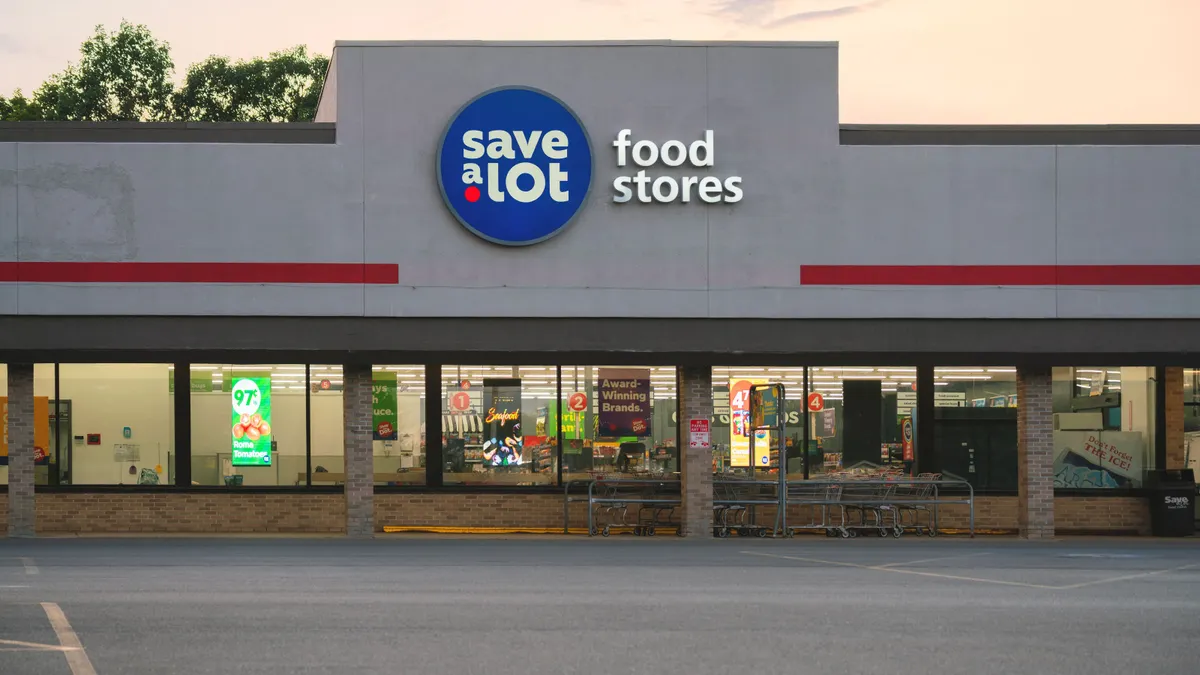
Save A Lot’s footprint has declined sharply during a rollercoaster period for the company and for the industry. What started as an approximately 1,000-store footprint in 2020 has dwindled to about 650 locations, the company confirmed with Grocery Dive.
The grocery industry has been buffeted by strong and unexpected forces over the past six years, from the onset and height of the COVID-19 pandemic to record-high inflation to the rollback of SNAP benefits. But while other low-price retailers have expanded their store fleets in a bid to cement themselves as low-budget solutions for consumers during these times of turmoil, Save A Lot has struggled to do the same.
David Buffa, Save A Lot’s chief legal and development officer, confirmed the company’s drop in store count and said it was the outcome of a challenging macroeconomic environment.
“The declining store count is not attributable to ‘Save A Lot has decided that it no longer wants to grow.’ We’re a for-profit business. Growth is a big part of our strategy, and stores that have left the network are largely ones that we did not see as viable and worth pursuing long term,” Buffa said in an interview. “And what stores remain, they are ones that we see as really providing a strong base for our future growth.”
The pullack in its store count has impacted the discount grocer’s geographic reach — Save a Lot no longer has a presence in Texas, Louisiana and Rhode Island — as well as its distribution network. In 2020, the discounter operated 14 distribution centers, but today the company runs about half that number — a change that was largely due to “changes in the store footprint and volume,” Buffa said.
The discounter faces steep competition from the likes of Aldi and Walmart. Research conducted by consumer data firm Dunnhumby shows that Save A Lot’s base price perception has worsened every year since 2021 while close competitor Aldi’s has held steady, said Erich Kahner, the firm’s head of competitive insights and strategy. Save A Lot had an advantage in base price perception over Walmart in 2021, but that has been erased, he said.
Kahner said he wasn’t surprised that Save A Lot’s current store count is down by hundreds of locations compared to 2020, stating that the discounter has historically ranked in the bottom half of Dunnhumby’s Retailer Preference Index in terms of value proposition.
So what happened to Save A Lot’s store count over the past six years? And what is the discounter doing to address the matter?
Save A Lot’s store count dropped roughly 35% from 2020 to 2025
A decade of change
In 2016, Supervalu, which had inherited Save A Lot in 1994 as part of a larger acquisition, sold the discount grocer to private equity firm Onex for roughly $1.4 billion.
In the decade that followed, Save A Lot experienced a bevy of financial and leadership changes, including six different CEOs at the helm. Bill Mayo, the company’s current CEO, stepped into the top role last summer.
Onex exited its investment in 2020, leaving the grocery company mired in debt. That year, Save A Lot secured $138 million from lenders, which helped reduce its debt by more than $400 million. At the end of 2022, Save A Lot completed a major debt refinancing.
By August 2023, Save A Lot announced the completion of a multi-year effort, which started in 2020, to offload corporate-owned stores and transition to an entirely wholesale business.
Alongside the company’s myriad corporate changes, the grocery industry since 2020 has battled sudden shifts in shopping behavior tied to the COVID-19 pandemic, inflation and supply chain issues as well as ongoing economic challenges. All of these have spurred consumers to trade down to private brands and pivot to retailers, like Walmart, with everyday low prices.
Even as the number of stores carrying the Save A Lot name has declined by hundreds of locations in recent years amid its restructuring and business model shift, the company has talked about growing its store fleet.
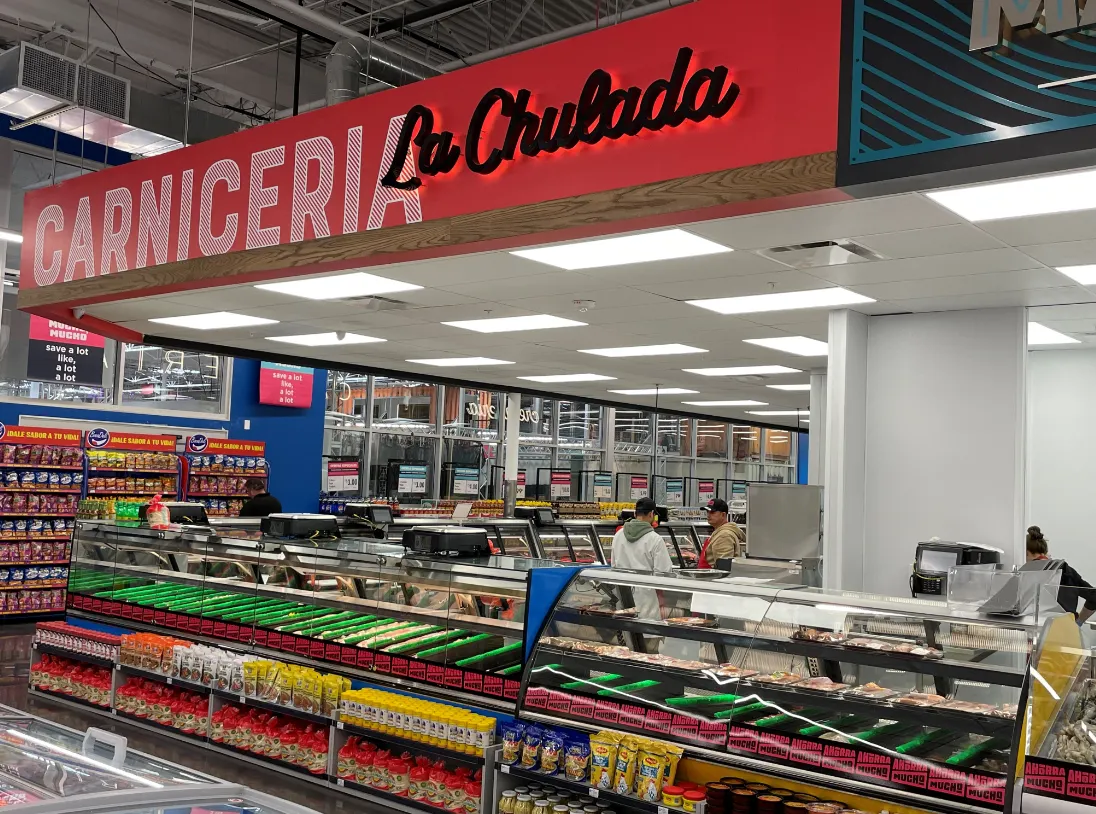
At the start of 2025, Mayo told Grocery Dive that “we expect 2025 to be a growth year for us,” with plans to open more stores, including under its Ahorra Mucho Hispanic-focused format, which the company runs through a partnership with another retailer.
A year prior, Mark Kotcher, then the company’s senior vice president of field sales and marketing, said at the National Retail Federation’s Big Show conference that the discount grocer could triple the number of stores carrying its name.
How the Save A Lot model works
The majority of the approximately 650 stores carrying the Save A Lot name are run by other retailers through a licensee-owned model. Under the system, Save A Lot provides the licensing opportunity and access to the company’s distribution along with its private label portfolio.
Save A Lot says that its licensing structure has fewer hurdles than a traditional franchise model. For example, the company says that it does not have initial franchise or royalty fees and gives flexibility for local owners to customize their operations.
Save A Lot provides wholesale services to nearly 650 brick-and-mortar banner-name locations, according to its annual report for 2025. The company also distributes its products in 24 countries across Latin, Central, and South America, and the Caribbean.
Bringing back the mixed-model strategy
The grocer’s sell-off of all its corporate-owned stores as part of its pivot to a wholesaler model didn’t last long. In January 2024, Save A Lot acquired more than 30 stores in Ohio and made them corporate-run locations, Buffa said. The owner of the Ohio stores was retiring, he noted, but Save A Lot wanted to keep these stores in-network — and doing that meant returning to its mixed-model business.
Save A Lot has continued to add corporate-run locations, he said, acquiring around 90 stores over the past two years.
“There’s a real benefit to having corporate-run locations because we can test things and we actually have to eat our own cooking and we know what works and what’s good for the customers in those stores and we can push it out to the network,” Buffa said.
Today, the discount grocer operates about 125 corporate-owned locations, per its 2025 annual report, and counts around 520 licensee-owned stores operated by roughly 150 retail partners, according to Buffa.
Save A Lot plans to maintain its mix of corporate- and licensee-owned stores moving forward. Having retail partners manage a large portion of Save A Lot’s footprint means individual operators shoulder the costs of running those stores, Buffa said.
Seventy percent of Save A Lot’s retail partners are single- and two-store owners who live in the communities where they operate stores and have a strong connection to shoppers, Buffa said.
Dunnhumby data shows that consumers view Save A Lot as a food retailer with a strong local community connection, noting that the discounter ranks alongside strong regional chains in this metric in Dunnhumby’s Retail Preference Index.
“That tends to be an unusual position for a discounter [or] a larger, more national chain to occupy,” Kahner said.
However, a strong connection to the community doesn’t always translate to strong sales. Kahner said Dunnhumby’s research shows that corporate-run retail banners tend to have stronger value propositions than licensed operations.
Although the firm’s research shows that Aldi, which operates all of its stores, scores much lower than Save A Lot in terms of community connection, the fast-growing discounter ranks higher than Save A Lot on base price perception. Save A Lot also ranks very low on the perceived quality of its products, ranking 80th out of 81 retailers measured.
“It’s not necessarily that if you’re a franchise or licensed chain that you’re guaranteed to struggle compared to a corporate chain,” Kahner said. “It’s just the range and variability in customer experiences from location to location or geography to geography is much wider if you’re a franchise or license chain.”
Kahner added that while Save A Lot exhibits strong ties to local communities, Dunnhumby has found that the discount grocer’s performance and value proposition fluctuate significantly from region to region. Meanwhile, corporate-run retailers tend to have consistent rankings in this performance area regardless of the market being analyzed.
As Save A Lot looks to continue bolstering its connections to local communities, the company has opened stores over the past six years under new formats, such as its Hispanic grocery banners Ahorra Mucho in Colorado and Save A Lot y Mas in Missouri.
Looking ahead, Save A Lot plans to closely monitor its store portfolio and learn from operators who are seeing success. “We think that we should be growing from where we are now,” Buffa said.
The impact of SNAP
One major impact on Save A Lot’s business — and a challenge to its future growth — is the discount grocer’s reliance on SNAP spending, which has declined significantly amid cuts to the federal program.
Save A Lot has one of the highest SNAP usage rates among U.S. grocers, with 26% of its customers currently receiving SNAP benefits and 25% of them no longer receiving SNAP, Kahner said, citing 2026 Dunnhumby data.
The discounter’s SNAP usage rates are significantly higher than both Aldi and Dollar General. Twelve percent of Aldi’s shoppers receive SNAP and 13% used to but no longer do. Dollar General, meanwhile, sees 25% of its customers currently using the food assistance program and 23% no longer having access to SNAP, per Dunnhumby data.
“Our stores have a material amount of revenue that comes from sales with SNAP and EBT tender,” Buffa said, adding that the pullback of SNAP increases introduced during the pandemic, plus the introduction of the Trump administration’s One Big Beautiful Bill Act, which cut back SNAP benefits, impacted store operations.
SNAP’s impact becomes an even more slippery slope for Save A Lot when factoring in the discounter’s ongoing struggle with value perception and where its consumers cross-shop, Kahner said.
Save A Lot’s three most cross-shopped competitors are Walmart, Aldi and Dollar General, with 75% of Save A Lot customers shopping at Walmart, 43% shopping at Aldi and 53% shopping at Dollar General, according to Kahner.
Save A Lot’s Walmart exposure is considerably higher than what other grocers face, he said.
“Those [cross-shopping percentages] are quite a bit higher for Save A Lot than other retailers,” Kahner added. “So the fact their value proposition is vulnerable to those retailers hurts them even more than it would other retailers because there’s a lot of competition overlap.”
What’s next for Save A Lot?
Getting back to its 2020 store count is not one of Save A Lot’s goals right now. For starters, e-commerce has “become a bigger focus for the company” over the past 24 months, Buffa said, noting that the company adopted both a new loyalty program and e-commerce platform.
Alternative wholesale is another avenue the discount grocer is exploring, he said. This move enables Save A Lot to sell its wholesale products to non-Save A Lot banners that don’t compete with its current footprint.
“It’s a more modern version of growth that’s prudent and doesn’t rely on, necessarily, having to build out rapid brick-and-mortar locations but is more akin to what you see other grocers having adopted,” Buffa said.
Save A Lot is also well aware that one of the aces up its sleeve is the discount grocer’s strong connection to local communities. Moving forward, the company aims to better communicate to customers, specifically those living in food deserts, that their stores have a better, fresher assortment than dollar-store competitors, Buffa said.
The discounter will continue to evaluate its existing footprint, looking for locations that will offer prudent, long-term growth and continuing to invest in them, according to Buffa.
“We have goals, but it’s not necessarily a firm number of ‘thou must have this many stores’ because we don’t think that should dictate the way we grow,” Buffa said. “But it’s rather a strategy for evaluating opportunities that make sense.”