

Someone tries a hot sauce at a friend's barbecue, sees it on a shelf
the following week, and a month later types the name into a search bar
and orders a case. To the brand's analytics that is a search sale, or
a direct one. A new study of 178,530 post-purchase survey responses
across 278 online food and beverage merchants finds that
recommendation is the largest single way shoppers say they discover a
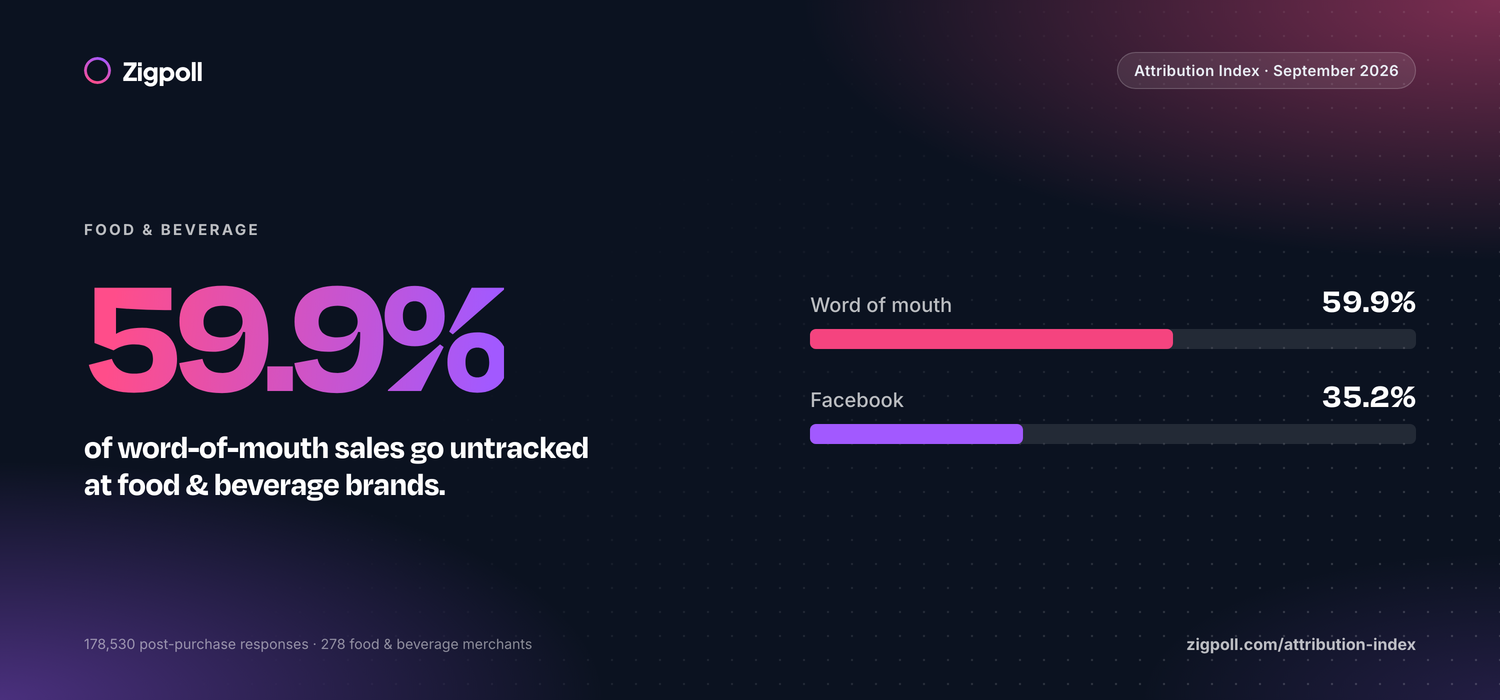
food brand, and that 59.9% of those sales reach the brand's reporting
with no source attached at all.
The Zigpoll Attribution Index, published by survey and attribution
platform Zigpoll, asked customers how they heard about the brand
immediately after purchase and compared each answer with the source
the merchant's own analytics recorded for that same order. Across all
food and beverage orders, 46.3% carried no usable source.
More customers named word of mouth (33,556) than named Instagram
(31,883), Facebook (31,417) or search (30,977). It was also the
channel most often lost. A sale that began on Facebook, which attaches
a click identifier to every visit, went untracked 35.2% of the time.
The gap between the two, a factor of 1.70, was the widest of the nine
retail categories in the study, with jewellery close behind.
The other ways a food brand earns trial fared little better. Customers
who first found the brand in a shop went untracked 54.5% of the time,
and customers who named a creator or influencer 54.2%.
"Food is a category people discover with their mouths, not their
browsers," said Jason Zigelbaum, founder of Zigpoll. "Someone tastes
it at a friend's house, sees it on a shelf, or watches a creator they
trust eat it on camera, and a week later they search the name and buy
it. The report credits the search. The sampling budget, the retail
listing and the creator who actually caused the sale show up as the
weakest lines on the dashboard, and the next budget gets set off the
dashboard. That is how a food brand ends up cutting the thing that
works to fund the thing that measures well."
Food and beverage customers were the least certain of any category
about how they had found a brand, but not by much: 12.5% of those
behind untracked orders said they did not know or could not remember.
The other 87.5% named a channel.
Share of orders with no tracked source, by the channel the customer
named:
- Word of mouth — 59.9%
- Retail or in store — 54.5%
- Creator or influencer — 54.2%
- TikTok — 49.8%
- YouTube — 46.9%
- Instagram — 42.0%
- Search — 39.8%
- Facebook — 35.2%
The Attribution Index is published quarterly. The full food and
beverage table is published at
https://www.zigpoll.com/attribution-index/2026-09/food-beverage
alongside eight other retail categories, all figures are free to
reproduce with attribution, and Zigpoll will provide further cuts of
the food and beverage data to journalists on request.
Methodology: Findings are drawn from 178,530 responses to "how did you
hear about us" questions, collected between 18 September 2025 and 18
September 2026 across 278 food and beverage merchants using Zigpoll.
Merchants were assigned to the category from the products appearing on
their orders; those whose product mix was ambiguous were excluded
rather than assigned. Only responses attached to a completed order
were included, so that a customer's stated answer could be compared
with the source recorded for that same order. No channel figure is
reported unless at least 25 of those merchants and 1,000 responses
stand behind it. Stores using Zigpoll are not a random sample of food
and beverage retail, and the figures describe that population rather
than the market as a whole.
Zigpoll is a survey and attribution platform for ecommerce brands, used to collect post-purchase, on-site and abandoned-checkout feedback and to connect what customers say to what they buy. The Zigpoll Attribution Index is published quarterly; the food and beverage table is at https://www.zigpoll.com/attribution-index/2026-09/food-beverage.