Dive Brief:
- Whole Foods Market announced Wednesday it will bring its Daily Shop small-format concept to three new U.S. markets — Boston, Chicago and Philadelphia — over the next two years.
- The specialty retailer has signed three leases so far, with one in each of the three major cities, but has yet to share opening dates.
- Whole Foods continues to helm the brick-and-mortar side of Amazon’s growing grocery empire, with plans to debut 100 more locations over the next few years.
Dive Insight:
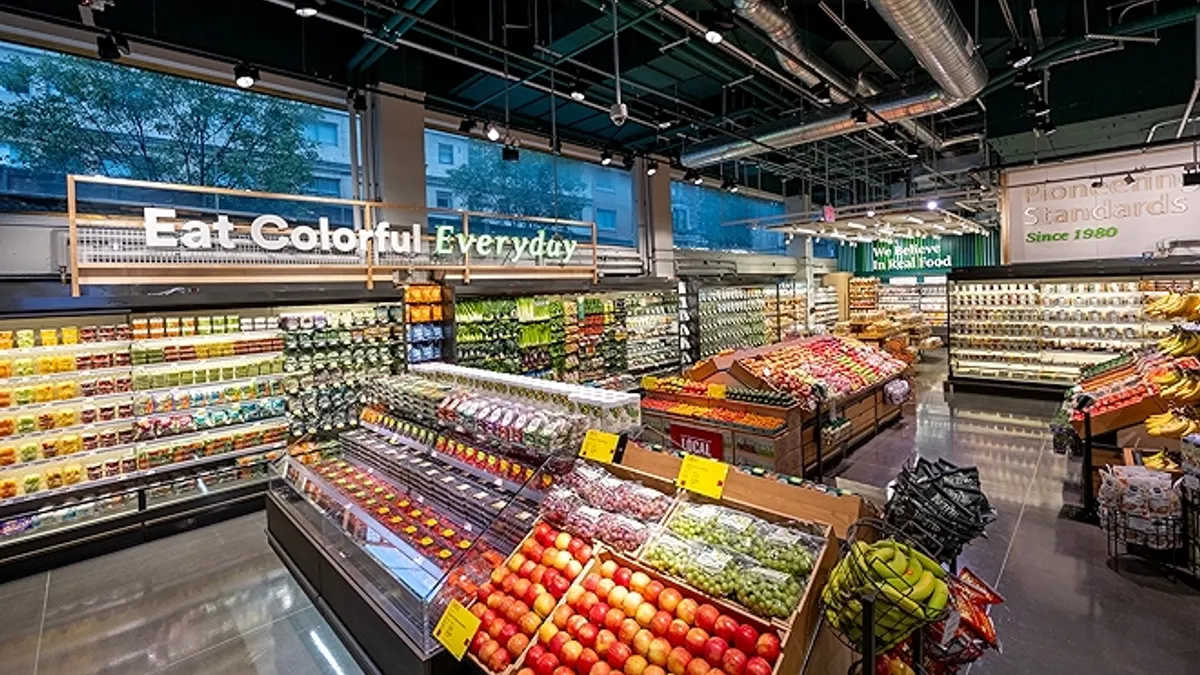
Since opening the inaugural Daily Shop store in New York City in 2024, Whole Foods has steadily expanded the concept’s footprint. Currently, New York City is home to five Daily Shops, and the concept also has locations in Hoboken, New Jersey; Arlington, Virginia; and London.
Whole Foods noted in an email that more Daily Shops will open in the New York City area and London later this year.
Whole Foods has signed leases at 111 Harbor Way in Boston’s Seaport district; 1200 N. Ashland in Chicago’s Wicker Park neighborhood; and 2221-2225 South St. in Philadelphia, per the announcement.
Like other Daily Shop locations, these incoming stores will offer fresh produce, meat and seafood, prepared foods, bakery items and 365 private label items, plus showcase local and regional suppliers, all within the scaled-down store model.
The specialty grocer noted that the Daily Shop stores will continue to serve as a way for Whole Foods to test new approaches to assortment and presentation, “with insights informing future store designs.”
“Daily Shop is an important part of how we’re growing our physical store presence,” said Christina Minardi, Whole Foods’ and Amazon’s vice president of real estate and store development. “As we expand this smaller format into new cities, we’re continuing to deliver the same high standards and carefully curated assortment Whole Foods Market is known for, in a way that meets our customers’ everyday needs.”
As Whole Foods continues to experiment with its in-person shopping experience, parent company Amazon is rapidly expanding its e-grocery operations.
The two companies made waves late last year when they debuted an in-store micro-fulfillment center inside a Pennsylvania Whole Foods. The MFC enables the specialty grocer to sell more traditional grocery items found on Amazon’s online marketplace without sacrificing the health and wellness reputation on Whole Foods’ shelves.
Meanwhile, Amazon recently entered the B2B grocery space and further ramped up its rapid delivery service, which includes perishable foods.