The Friday Checkout is a weekly column providing more insight on the news, rounding up the announcements you may have missed and sharing what’s to come.
Kroger CEO Greg Foran has spent the early months of his tenure talking about improving the fundamentals of the supermarket chain’s business — namely, lowering prices and stepping up execution in its fresh departments. But the company can’t afford to lose sight of an e-commerce business that has become quite messy in recent years.
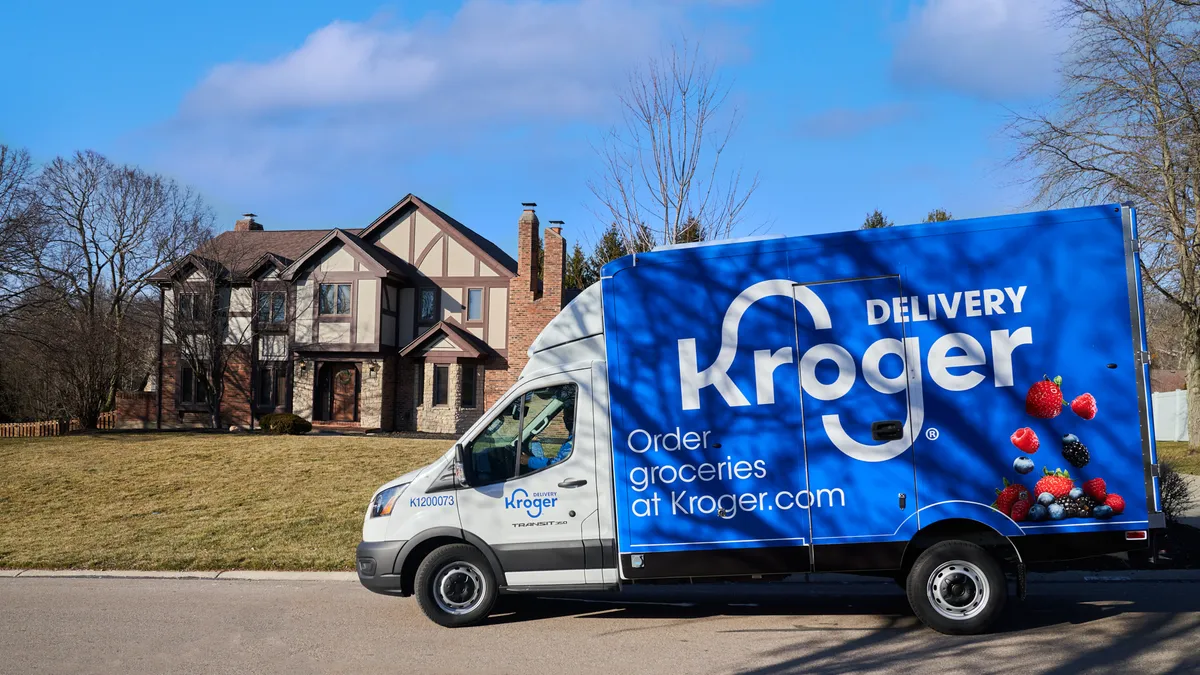
Kroger’s proprietary delivery service, which launched several years ago and was supposed to herald the future of online grocery shopping, appears to be growing increasingly out of touch. The service, which relies on large, automated fulfillment centers built by British tech firm Ocado, cost a lot of money to run at a time when efficiency has become the watchword for retailers. And its slower fulfillment speeds compared to third-party delivery companies like Instacart and DoorDash don’t jibe with consumer preferences.
Nate Faust, Kroger’s new chief e-commerce officer, inherits the responsibility of sorting through this very expensive conundrum. As the founder of two online services — Jet.com and Olive — he no doubt has his finger on the pulse of consumers and a soup-to-nuts understanding of how e-commerce businesses work. As a company outsider, he can also bring fresh thinking to the Ocado network — and determine if it fits at all into Kroger’s evolving strategy. Faust also brings a particular expertise in logistics, having spent several years as Walmart’s SVP of e-commerce supply chain after the big box retailer bought Jet for $3.3 billion, indicating he’s well suited to evaluating Kroger’s delivery network.
Kroger has closed several facilities in its e-commerce fulfillment network over the past two years, and it may need to close more as Ocado’s delivery systems continue to struggle globally and as fulfillment increasingly centers on stores. Canadian grocer Sobeys announced earlier this year that it would close an automated facility in Calgary that was producing underwhelming returns. Ocado’s own online grocery business in the U.K. is struggling against rapid delivery firms.
For Kroger, e-commerce is a valuable part of a flywheel that includes retail media and store sales. If the company wants to compete with the big players like Walmart and Amazon, it needs to sort out its overly complex digital business.
In case you missed it
Another Meijer Grocery gets ready to open
The store in Fishers, Indiana, will open Sept. 30, according to Meijer. Once this 75,000-square-foot location goes live, it will mark the second Meijer Grocery in Indiana and sixth under the banner, which debuted at the end of 2023.
H Mart goes for seconds with Orlando food hall
The Asian grocery chain plans to open an extension of its food hall at its store in Orlando, Florida, next Friday. The food hall, which opened last year along with the store, will add six new dining stalls, including a Japanese curry one and several Korean options.
How did July’s inflation fare?
Food-at-home prices rose at a 2.7% annual clip in July — the same pace as in June and May — according to Consumer Price Index data released this week by the U.S. Bureau of Labor Statistics. Meanwhile, overall inflation hiked up 3.4% in July.
Impulse find
Giant Eagle makes a statement with mega-sized shopping cart
Some grocers like to make a statement by naming autonomous aisle-roaming robots as their unofficial mascots. Giant Eagle has decided to go bigger with its “Giant Buggy” — a massive, motorized shopping cart.
The Giant Buggy hit the streets earlier this month around the chain’s two newly remodeled stores in Cranberry Township and West View, Pennsylvania, the grocer said in an emailed announcement. Those upgrades are part of a larger remodeling initiative that Giant Eagle said aims to “reinforce its position as a leading grocer in the Pittsburgh region.”