The Friday Checkout is a weekly column providing more insight on the news, rounding up the announcements you may have missed and sharing what’s to come.
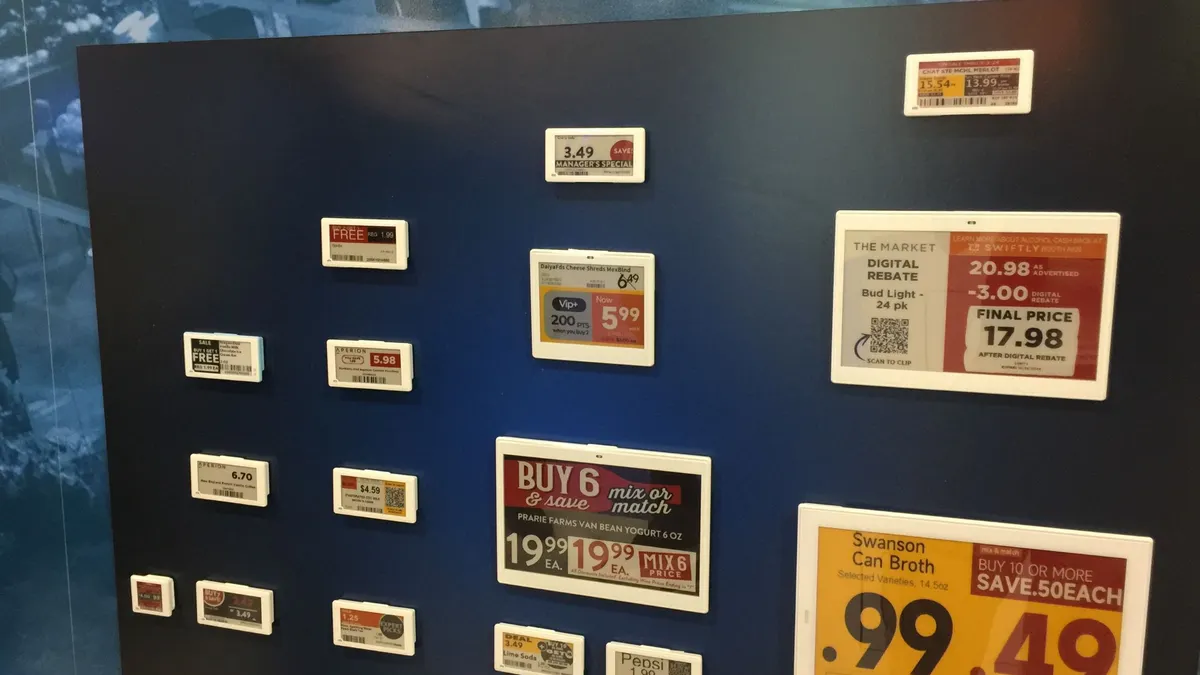
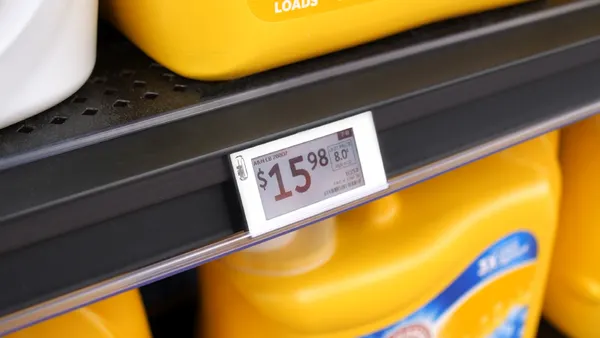
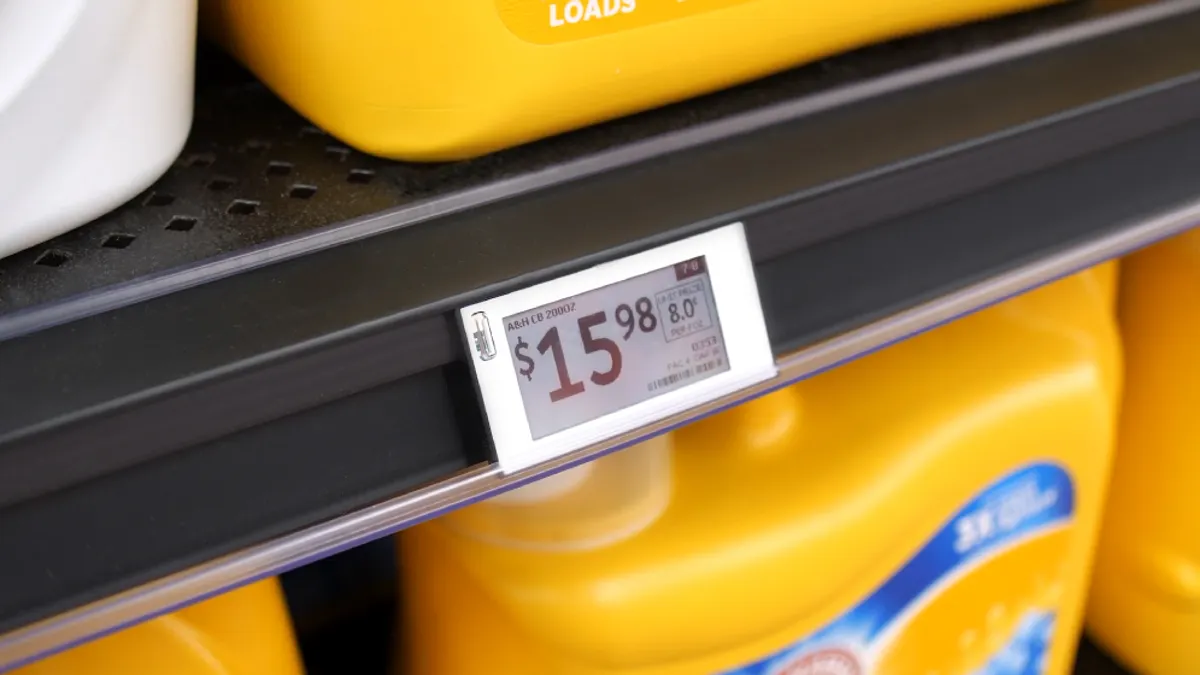
Retailers have recently faced an onslaught of criticism from state and federal politicians over their use of electronic shelf labels — and now the grocery industry’s largest trade association is fighting back by highlighting how the tech can help, instead of hurt, the grocery labor picture.
Addressing concerns that ESLs, also known as digital shelf labels, will prompt retailers to cut jobs, FMI — the Food Industry Association said the equipment will not cost workers their jobs and instead actually help grocers deal with labor shortages.
“Banning DSLs would force grocers to rely on slower, more wasteful, more costly and less accurate paper-based systems,” Michael Green, FMI’s director of state and local government relations, wrote in a blog post earlier this week.
ESLs have also come under scrutiny by lawmakers over concerns that retailers would use consumer data to make pricing decisions and then leverage ESLs to quickly manipulate prices. But Green hit back on those claims, too, writing that grocers “do not use DSLs to enable ‘surge pricing,’ surveillance-based pricing or to set prices at all. DSLs do not collect personal information, do not track shoppers and do not change prices while you browse.”
The hoopla over ESLs is coming as Walmart rolls out digital shelf labels to all of its U.S. locations. Other top companies, such as Kroger, Whole Foods Market and Aldi, have also adopted the technology. As the industry looks to fend off consumer advocacy concerns around ESLs, retailers need to be mindful of the broader economic pressures that are fueling worries about how fair the prices consumers are paying at grocery stores — a key topic that Grocery Dive is exploring in a series about how grocers are communicating value beyond yellow tags.
In case you missed it
Road to new PCC store nears the finish line
The Seattle-based grocery cooperative expects to open a new location in Seattle’s Madison Park neighborhood this fall — a decade after signing a lease for the site. The store, at 2925 E. Madison St., will offer locally grown organic produce, seasonal products sourced from across the Pacific Northwest, and ethically raised meat and seafood.
“[I]t’s been a long road to get here as the project worked through the local process, with input from the neighborhood along the way. That makes it especially meaningful to finally open our doors and put down roots here,” PCC Community Markets Acting CEO Amy Chow said in a statement.
Thrive Market sets its sights on CO2 and plastics
The e-grocer has started a working group to help its suppliers reduce their carbon dioxide emissions and plastic use as part of its efforts to drive sustainability efforts across its supply chain.
Thrive Market’s goal is for all vendors that provide it with name brand and private label goods to measure and set targets for reducing their CO2 and plastic footprints. Thrive Market wants partners that have already started cutting back on their CO2 emissions or plastic consumption to step up those efforts.
Data paints a pretty picture for protein
More than half of consumers are taking purposeful steps to boost their intake of protein, according to research Numerator presented at the Expo West trade show last month. The data analysis company also said a survey it conducted showed that people pay more attention to protein than to sugar, fat or calories, underscoring the durability of the growing trend toward increased consumption of the macronutrient.
“The question is no longer whether protein will last, but which brands will capture that repeat behavior,” Numerator said in a blog post.
Impulse find
Instacart puts a small feature on a big stage
The grocery e-commerce provider’s “Preference Picker” feature might be all about helping people customize little details, but that hasn’t stopped the company from using the capability to help define its brand in a big way. After making Preference Picker the star of its Super Bowl ad this year, Instacart recently released new, elaborately produced ads to highlight how shoppers can personalize their orders.
One of the spots features a young boy expressing his desire for thin ham. A quartet of musicians then acts out his request as they sing about making “the sandwich of your dreams.” Another features a shopper joining the crew on a fishing boat (appropriately named “The Instacart”) in a quest for thick, skinless, boneless whitefish.
In the words of DesignRush, an online platform that matches brands with advertising agencies, “Every small, relatable grocery concern triggers a surreal musical sequence, and ordinary shoppers transform into performers navigating exaggerated versions of their preferences.”