As Kroger looks to move past the fallout from its failed merger with Albertsons, the country’s largest supermarket operator is eager for a turnaround.
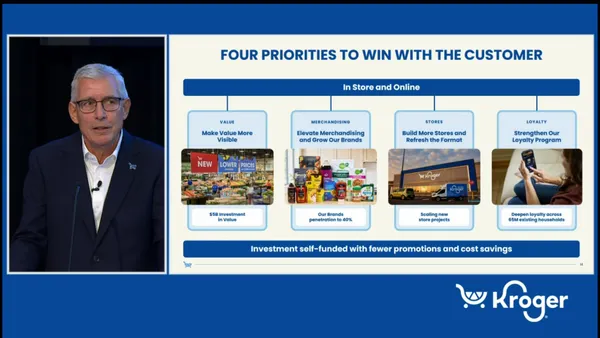
CEO Greg Foran outlined three priorities for the grocery company’s path forward during Kroger’s Investor Day on Tuesday: serve customers better, drive profitable digital growth and modernize operations.
Kroger’s first goal centers on value, an area it pledged to invest heavily in and simplify for shoppers.
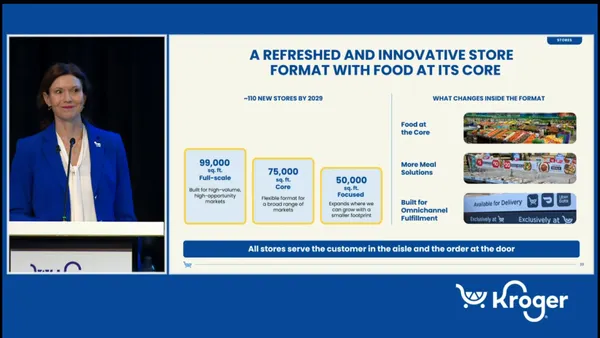
The second objective focuses on ramping up e-commerce and creating a more seamless digital and online shopping experience. Kroger aims to bring more of its fulfillment operations in-house, and its newly announced “Fresh” store formats include space for e-commerce backrooms to support this effort.
Kroger is also looking to modernize operations by investing in tech like digital shelf labels, artificial intelligence and robotics, as well as improve the supply chain through automation. “Every single one of these actions has the same goal: take cost and complexity out, put the savings back into customer value and execution, and expand margins over time,” Foran said.
“We have what we need. Now we execute,” he said.
Here are five key numbers in Kroger’s new three-year turnaround plan.
$5 billion
Amount Kroger plans to invest in value
Foran has been clear since taking over the top post earlier this year that he wants Kroger to offer a better value proposition to attract and retain shoppers. On Tuesday, the retailer offered color on how it intends to achieve that goal.
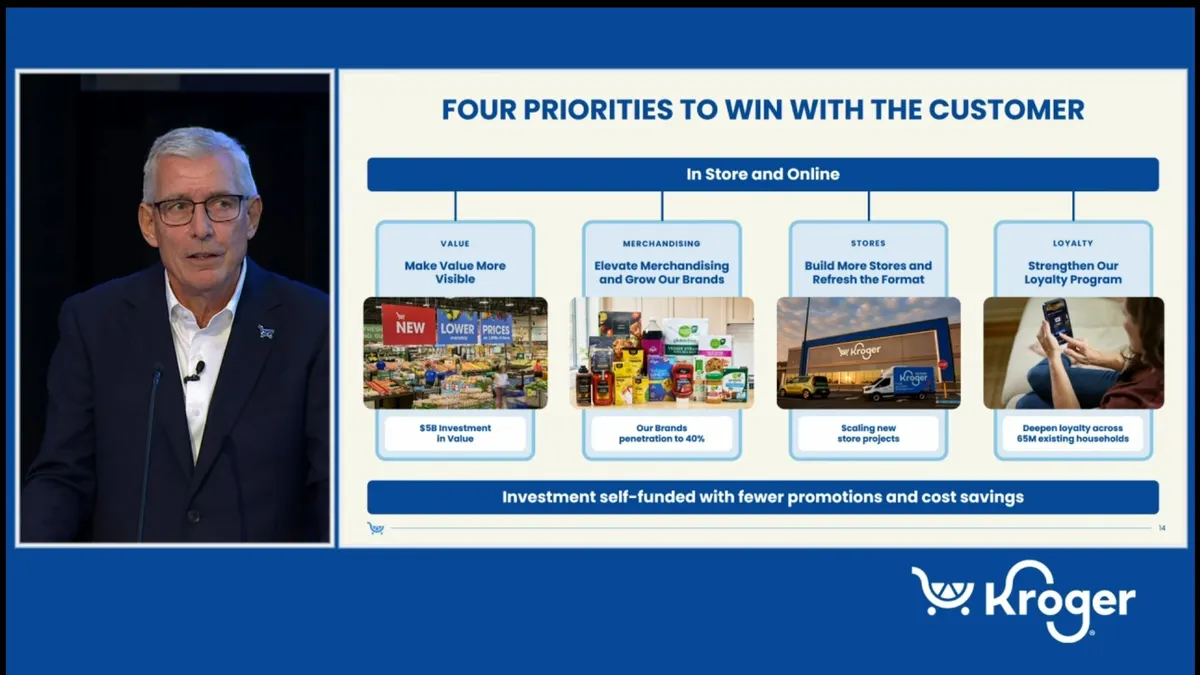
By 2029, Kroger aims to self-fund a $5 billion investment in value initiatives for customers by implementing cost-cutting measures and reducing its reliance on promotions, CFO David Kennerley said.
“[W]e will steadily reduce reliance on the lower return and overly complex promotions and replace them with more relevant value that delivers better results,” he said. “That discipline is what lets us improve the value customers see while protecting and growing the long-term earnings power of the business.”
Kennerley also said that Kroger will take steps to protect its margins as it looks to provide value. “We remain confident in our plans to balance these investments while growing our margins over time,” he said.
Kennerley said the company plans to modulate the speed at which it channels cost savings and productivity improvements into lower prices depending on how well its efforts to cut expenses unfold. “The pace is in our control, and we’re committed to managing it in a disciplined way,” she said.
3%
Comparable-store sales growth Kroger hopes to reach by 2029
After watching its comparable-store sales growth wane over the past few quarters, Kroger sees a road to much stronger results. By 2029, the grocer hopes to bring its comps to about 3%, excluding fuel and pharmacy sales. Mary Ellen Adcock, Kroger’s chief merchant and marketing officer, said the company plans to achieve that target by sharpening the customer experience, prioritizing value and expanding e-commerce.
According to Adcock, the company’s effort to improve the customer experience will center on making its value messaging clearer, lowering everyday prices and simplifying promotions. The company also plans to improve merchandising and expand its private labels, areas where Adcock said the grocer “has a right to win.”
Kroger also hopes to push sales ahead by growing its digital operations, which Chief E-Commerce Officer Nate Faust said could eventually represent 30% of the company’s business. To drive e-commerce growth, Kroger plans to offer a better fresh selection, increase delivery speeds and use AI to deepen relationships with online customers, Faust said.
40%
Kroger’s private label penetration target
As Kroger strives to position itself as a destination for meals, the company sees an opportunity to expand the role its house brands play in driving sales.
According to Adcock, Kroger is on pace to increase its private label penetration to 40% in the coming years from the current level of 35%. The company’s premium Private Selection line is expanding especially fast, and Kroger projects that it will grow at a 15% yearly clip through 2029, she said.
Kroger also intends to bolster its value-focused Smart Way line in a bid to connect better with budget-focused shoppers. The retailer plans to introduce 1,000 items under the brand over the next few years, Adcock said.
In addition, Kroger plans to nurture its Simple Truth natural and organic brand by investing in popular items like protein products, she said.
$500M
Kroger’s goal for incremental e-commerce EBITDA by 2029, excluding media
Kroger wants to deliver a better customer experience while also driving profitable growth, and it sees bringing more of its customers online as a key way to accomplish this.
A cornerstone of the grocer’s three-year plan is getting more customers to shop digitally by increasing the density of orders across its network and using technology to fulfill them more efficiently, Kennerley said
The company will continue to place a priority on store-based fulfillment, in part by including dedicated space for workers to handle pickup and delivery orders in new stores it plans to build, Adcock added.
10%
Percentage of products Kroger aims to directly source by 2029
Currently, Kroger directly sources less than 1% of the products it carries, Kennerley said. That leaves significant room for improvement, because directly sourcing products means Kroger gains “more control over the economics and a clearer view of what we are paying for,” he said.
By 2029, Kroger intends to increase the percentage of items it carries that it acquires directly tenfold and has made “good progress” toward reaching that goal, Kennerley said.
The retailer has already launched hubs in South America and Asia with spokes in key sourcing locations, which Kennerley said are steps towards Kroger’s long-term goal of operating a fully-owned import distribution model.
For example, Kroger is working with large grape producers in Peru and has secured approximately 40% of its imported grape supply from those growers, with support from service partners, he said.
“Previously, we would have paid margin to a third party to sit between us and the grower. And by doing this ourselves, we use Kroger's scale to get closer to the grower, which lowers costs, strengthens access to supply and gives us a more direct line to innovation,” Kennerley said.