Dive Brief:
- Kroger will debut three updated store formats as it plans to open 110 locations over the next three years, executives said Tuesday at the company’s investor day.
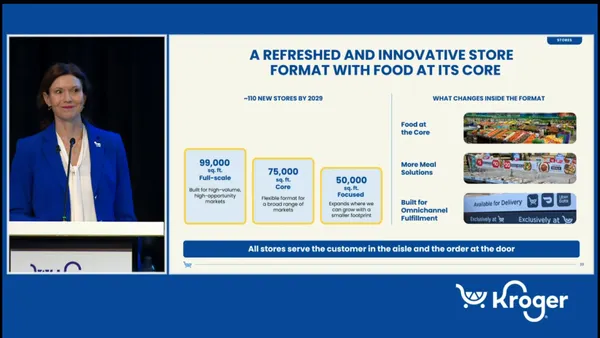
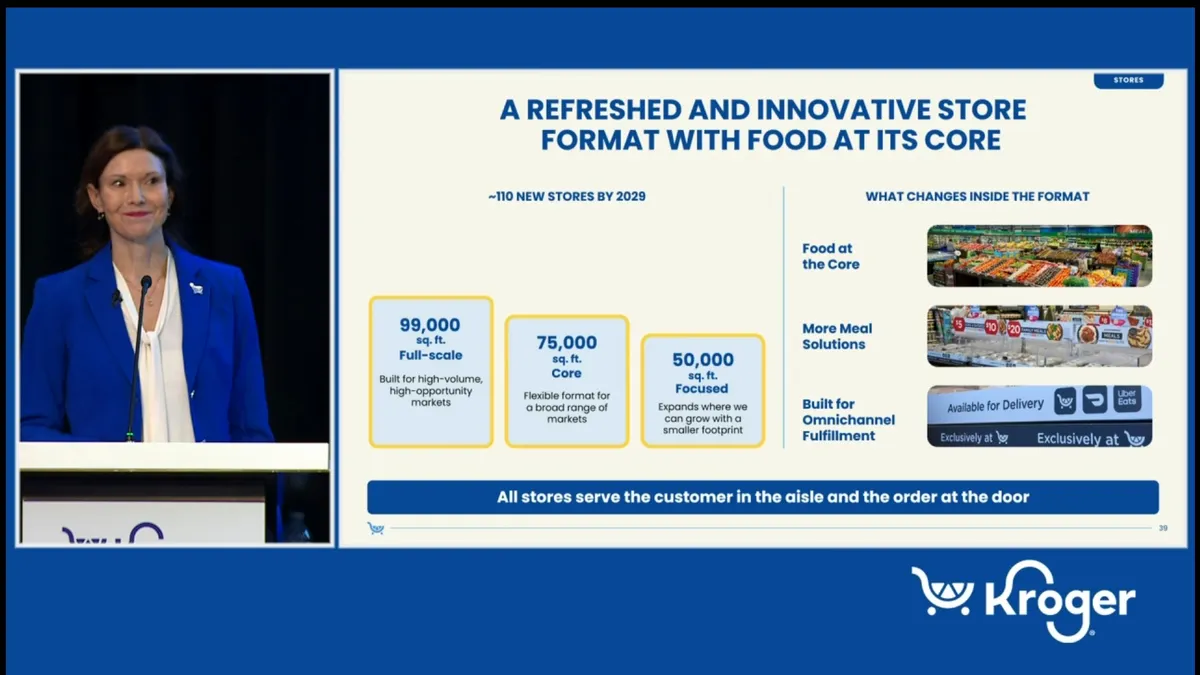
- The refreshed designs range from 50,000 square feet to 99,000 square feet, with more room for meal solutions and fresh offerings along with added in-house e-commerce fulfillment space where it’s needed.
- These new store concepts are part of Kroger’s $5 billion investment in its stores, operations and pricing as it seeks to reach approximately 3% comparable sales growth in 2029.
Dive Insight:
Kroger’s refreshed store formats aim to create a food-first experience and expand three key departments, fresh, meal solutions and private label, said Mary Ellen Adcock, Kroger’s executive vice president and chief merchant and marketing officer, during Tuesday’s event in New York City. The stores will also each have a redesigned e-commerce backroom with more capacity for pickup and delivery, she added.
Kroger plans to open 110 new stores under its “Fresh” formats by 2029 alongside store remodels, Adcock said, adding that the company’s three new store designs, which vary by size, aim to meet the needs of individual markets.
The new 99,000-square-foot design is built for “high volume, high opportunity” markets, while the 75,000-square-foot format can serve a broader range of markets, she said. The 50,000-square-foot refreshed store concept, meanwhile, enables Kroger to bring its stores into markets where a smaller footprint makes sense, Adcock said.
While these new formats expand fresh offerings as well as backend e-commerce capabilities, they also devote less space to areas that don’t resonate as well with shoppers, like general merchandise and apparel, Adcock said.
The new formats also lean into Kroger’s connected store initiative, which includes an enhanced app experience for shoppers as well as artificial intelligence technology that supports in-store staffers and allows them to spend more time on customer-facing tasks.
The new store formats are smaller than the Marketplace stores Kroger has been rapidly building and opening in recent years. Those locations, which range from 99,000 to 130,000 square feet, feature a wide range of non-food items and have debuted in states like Kentucky and Texas, where Kroger is fiercely competing with regional competitors like Publix and H-E-B.
CEO Greg Foran added that Kroger is investing in new in-store technology, including digital shelf labels, robotics and AI that will help the grocer act faster and update its shelves more accurately.
According to Kroger CFO David Kennerley, the grocer expects the new stores to be the biggest driver of the company’s sales increase, generating approximately $7 billion in annualized incremental sales at maturity over the three-year period.
He added that Kroger will prioritize opening new stores in high-growth markets, adding local density to strengthen the company’s market position.
In addition to its 3% comparable store sales growth goal, the grocer is also targeting 7% to 11% compound annual growth in adjusted net earnings per share through 2029, replacing an earlier target of 8% to 11% growth. Kroger is also targeting 3% to 6% compound annual growth in earnings before interest, taxes, depreciation and amortization during the same time period.