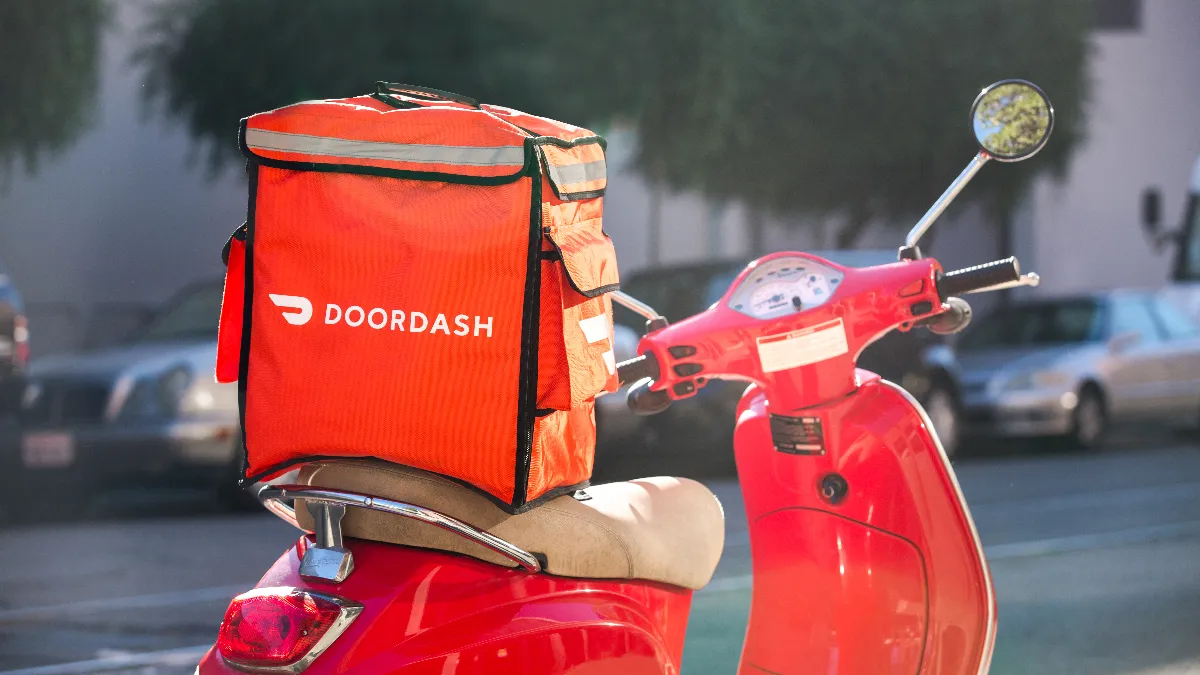
DoorDash has placed an order for Instacart’s grocery e-commerce empire.
The food delivery giants announced last week that they want to join forces in a proposed $17 billion deal that they say will help retailers better compete against the largest industry players.
With the deal, the companies are poised to expand beyond their core areas — restaurant delivery for DoorDash and grocery e-commerce for Instacart — and better compete against e-commerce giants like Amazon and Walmart. But key questions linger, including what value, if any, the deal offers for grocers.
Some industry experts said they believe the deal will give DoorDash a stronger long-term competitive position that could ultimately benefit retailers, while others — including advocacy groups for workers and consumers — claim the deal raises antitrust and labor issues.
The benefits of scale
In announcing their merger, Instacart and DoorDash stressed that their combination will help retailers better compete against industry behemoths.
“The biggest online retailers and grocers are racing ahead, building their own delivery fleets, warehouses, membership programs, and AI shopping assistants,” the companies said. “A grocer or retailer running on thin margins cannot build all of that alone, and with AI, the playing field risks being tilted even further away from local commerce.”
While both are in the business of e-commerce, Instacart and DoorDash have different strengths that blend well together, some experts said.
Instacart’s retailer relationships, grocery technology and advertising capabilities are “highly complementary to DoorDash’s business and grocery initiative,” according to a research note from financial services firm William Blair.
“Given DoorDash’s progress in building out its grocery marketplace and DashMart Fulfillment Services, Instacart should meaningfully increase the scale over which these investments can be deployed, which can lower unit fulfillment costs and help amortize the fixed costs of inventory management infrastructure,” wrote Ralph Schackart, Jack Brenczewski and Justin Whitney, analysts at the firm.
The deal could help drive sales for grocers by offering them higher quality orders and faster deliveries, they wrote. Because DoorDash is expected to keep Instacart’s brand, enterprise technology products and app, customers and independent contractors can choose their preferred platform, they added.
Neil Saunders, managing director of GlobalData, also said he believes that by gaining additional retailer partnerships from Instacart, DoorDash could boost order densities and fulfillment efficiency and then create a financial model that could potentially lower costs for retailers.
“All retailers need to unlock efficiencies to compete, but very few of the regional and smaller supermarkets can afford the investment or justify the development of a network to rival either Walmart or Amazon in grocery,” Saunders wrote in emailed comments. “DoorDash gives them an alternative way of doing this.”
The combined companies’ scale could also help consumers by serving more of a household’s food needs, said Carlos Castelán, a consultant at technology and consulting platform Catalant.
“Whether someone wants to order a prepared meal or groceries to cook their own meal, the combined company could become a more convenient choice for both,” Castelán wrote in emailed comments. “That creates more opportunities to engage customers throughout the week and capture a larger share of their food spending.”
Scale alone, though, won’t be enough, Saunders said.
“[The] challenge will be to use the scale to fundamentally improve the economics of the business and the proposition for retailers,” Saunders said. “This also necessitates even more investment in innovation and infrastructure, which needs to be made on top of an already premium purchase price. That raises the bar for the returns DoorDash must ultimately deliver.”
Concerns over shrinking competition
Some prominent consumer and worker advocacy groups called for regulators to block the purchase.
The United Food and Commercial Workers International Union, which represents 1.2 million workers across North America, called the proposed deal “a nightmare for shoppers and workers alike.”
In a Friday press release, UFCW International President Milton Jones said that the companies’ combination would give them “even more power over the workers who make their operations run and be able to undercut good-paying, union grocery jobs at the same time.”
The American Economic Liberties Project, a nonprofit that advocates for corporate accountability legislation and antitrust enforcement, said in a statement that the combined e-commerce market share of DoorDash and Instacart could create a food delivery monopoly. The nonprofit claimed the deal would result in the companies using their power “to squeeze worker compensation on the way in and drain consumer wallets on the way out,” said Lee Hepner, the nonprofit’s senior legal counsel.
The American Economic Liberties Project, which is also campaigning against pricing practices that use personal data to set individualized prices for goods and services, pointed to Instacart ending a controversial pilot in late 2025 that allowed some retailers to test charging consumers different prices for the same products. The organization also highlighted that DoorDash and Instacart are among the nine companies the FTC recently ordered to share with the agency how personal data is used to set prices and compensation.
Groundwork Collaborative, a nonprofit and progressive advocacy group, also raised concerns that the deal could harm consumers if AI influences pricing in an unfair way.
Where does the deal go from here?
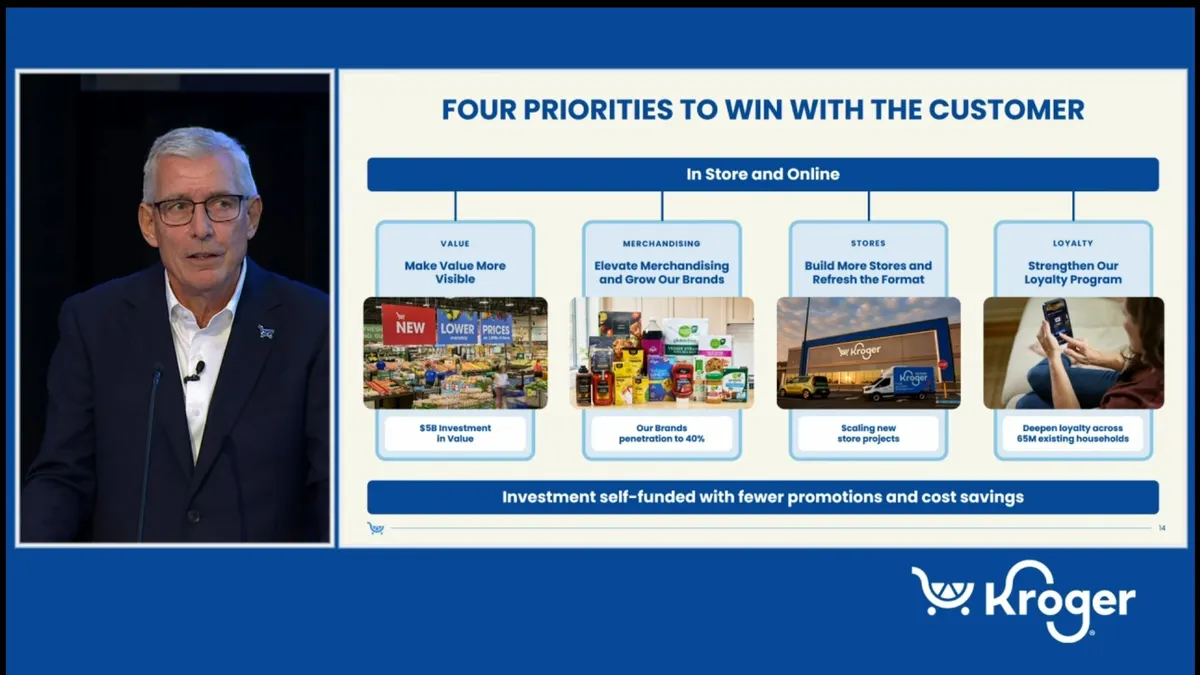
DoorDash and Instacart’s proposition — that scale is necessary in a retail landscape filled with behemoths — echoes the logic of the failed merger between Kroger and Albertsons. That merger proposal came at a time when the FTC was chaired by a staunch critic of corporate concentration, while the FTC appears to be more amenable to large-scale mergers and acquisitions under the Trump administration.
However, a new twist since the Kroger-Albertsons proposal was first announced in 2022 is the updated merger guidelines the FTC and the Department of Justice unveiled in 2023. Those guidelines “expand significantly the number and types of transactions subject to antitrust challenge,” law firm Holland & Knight noted in a blog post. Drafted during the Biden administration, the guidelines have remained in effect under the Trump administration.
If regulators greenlight the deal, Saunders said he expects one of DoorDash’s top priorities will be to improve the economics of picking and fulfillment, potentially by turning to dedicated and automated fulfillment facilities in key locations or by bringing DashMart-style fulfillment capabilities to more retail partners. He also expects the companies to focus on maintaining and growing trust with retailers.
“[There] is an inherent tension with retailers becoming too dependent on a third-party provider. Especially so when it comes to things like ownership of customer data and fees,” Saunders wrote. “DoorDash will need to ensure that it is seen as a partner that enables retailers to succeed, rather than an increasingly powerful intermediary that extracts value from the business. This may also be a potential area of regulatory scrutiny.”