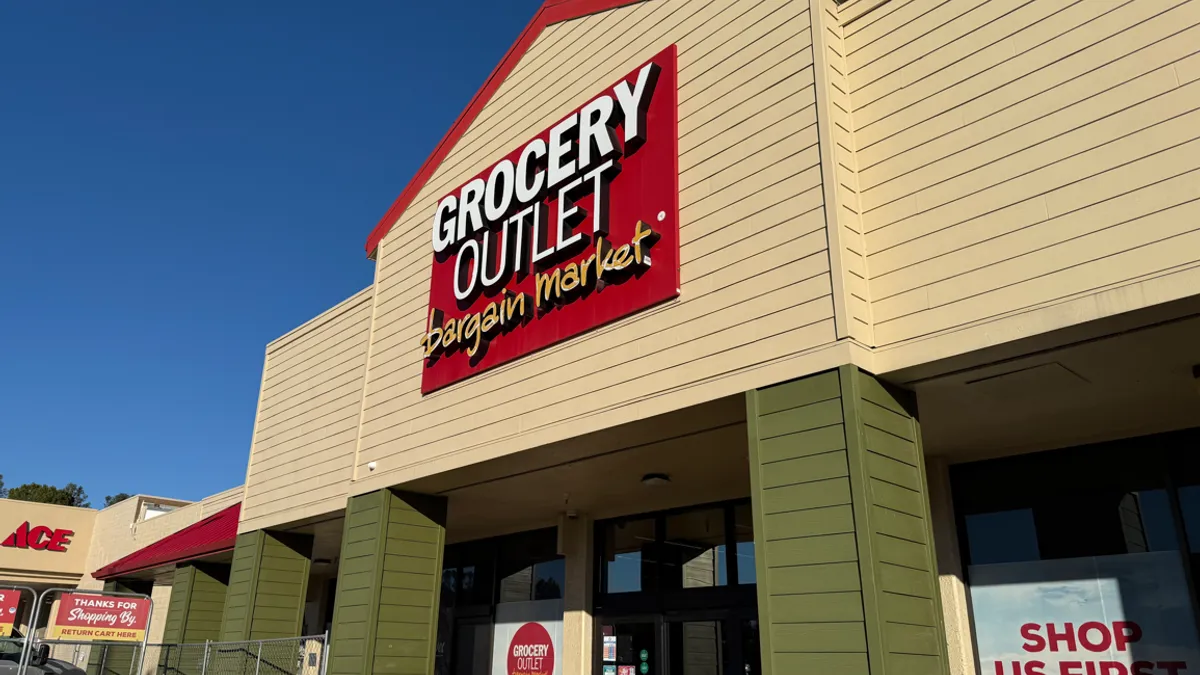
Grocery Outlet’s sales slumped in November when SNAP funding lapsed amid the government shutdown, the discount grocery chain said in a regulatory filing on Wednesday.
The discounter said that preliminary comparable-store sales in November tied to EBT payments declined by approximately 8.2% while non-EBT transactions fell by approximately 0.5%.
As a result of the November sales hit, Grocery Outlet said it expects its fourth quarter comp-store sales growth to be flat and diluted adjusted earnings per share to be at the low end of its previous forecast range of 21 cents to 23 cents. Grocery Outlet noted that the November sales results in the regulatory filing are preliminary and unaudited and have not been reviewed by the company’s independent registered public accounting firm.
“A lot of our customers are under pressure. We service a lower-income demographic, and the value that the business provides is important for those families to stretch their budgets,” Grocery Outlet President and CEO Jason Potter said during the Morgan Stanley Global Consumer & Retail Conference on Wednesday.
While sales declined in November, traffic remained positive and the units-per-transaction rate was stable compared to October, Potter said.
When announcing its third-quarter results in early November, Grocery Outlet updated its fiscal 2025 guidance to include comp-store sales growth between 0.6% to 0.9%, net sales to fall between $4.7 billion and $4.72 billion and diluted adjusted earnings per share to range between 78 cents and 80 cents. In the regulatory filing on Wednesday, Grocery Outlet revised its full-year forecast, saying it expects comp sales growth and diluted adjusted earnings per share to fall on the low end of that guidance.
CFO Christopher Miller told analysts on the Q3 earnings call that EBT payments accounted for roughly 9% of Grocery Outlet’s sales last year.
SNAP benefits lapsed on Nov. 1, and a legal battle ensued over how the federal government would tap contingency funds to temporarily cover benefits for the food assistance program. The shutdown ended when President Donald Trump signed on Nov. 12 legislation that includes funding for SNAP and WIC until the end of September 2026.
Potter indicated during the Morgan Stanley conference that it might be too soon to know if SNAP sales are back to normal. Typically, SNAP consumers spend their benefits shortly after receiving them, leading to a spike in SNAP sales during the first 10 days of the month, he said.
Grocery Outlet is one of the first grocers to share how the SNAP funding lapse impacted their financial results. Kroger reports its third-quarter results on Thursday. Grocery Outlet, Walmart, Sprouts Farmers Market and Albertsons are expected to hold their next quarterly earnings calls in early 2026.