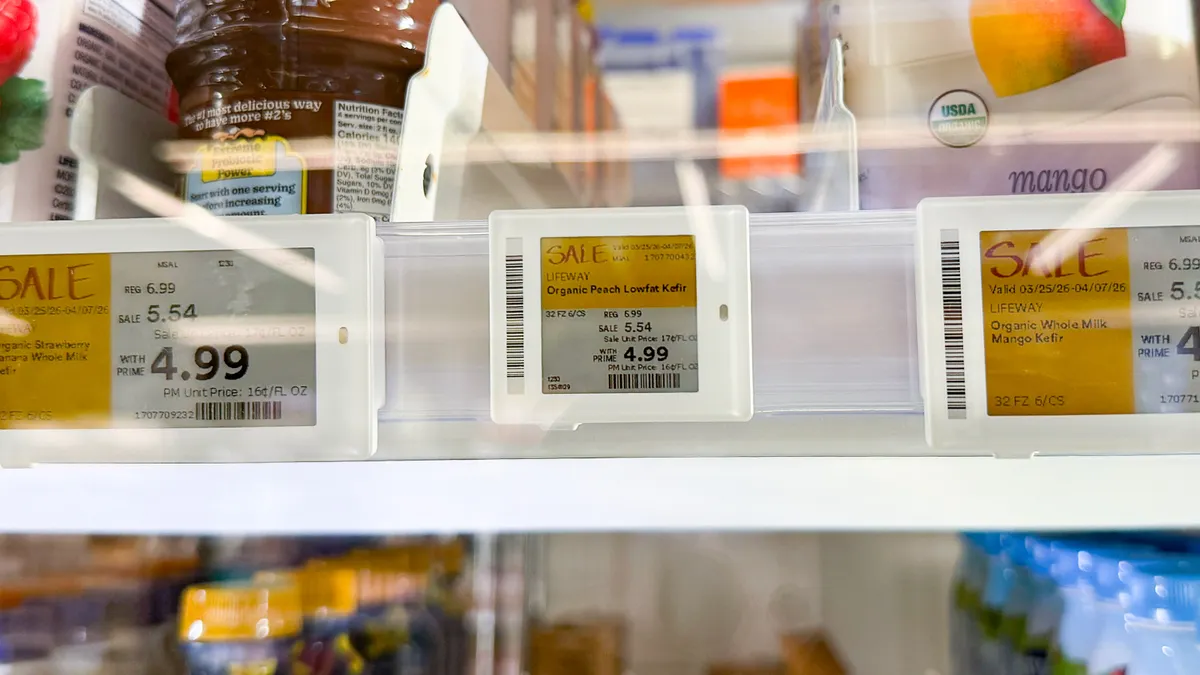
The mechanisms grocers use to determine what to charge for food have long drawn scrutiny and pushback from consumers, public policy groups, regulators and politicians — and those actions have sometimes had dramatic results.
For example, a federal court fined three Cleveland-area supermarket chains more than $4 million in 1982 for colluding to fix prices. In settling the case, the grocers also agreed to distribute $20 million in coupons to shoppers in what the Federal Reserve Bank of Cleveland described at the time as the largest consumer settlement in U.S. history.
In 1966, a woman in Denver upset over the rising cost of olives sparked boycotts of five area grocery chains after a store manager reportedly told her to “stick to your cooking and let us decide prices,” Money magazine recounted in 2016. Also that year, shoppers angry over high grocery costs staged “shopping cart blockades” that forced some supermarkets to lower prices.
More recently, the federal and state officials have been investigating — and in some cases taking action against — a more modern trend: Retailers using information about people’s individual shopping behavior to set prices through a practice known as dynamic or surveillance pricing.
Last week, New Jersey became the latest state to implement a law limiting how grocers can use data about consumers to compute what to charge individual shoppers for goods they buy. The law also targets electronic shelf labels, which critics have said grocers can use to rapidly adjust prices to the detriment of consumers. Proponents of ESLs such as FMI — The Food Industry Association say the technology can “improve price accuracy, reduce food and paper waste and enhance the shopping experience.”
Earlier in 2026, the governors of states including Maryland and Connecticut also signed measures that crack down on dynamic pricing. Lawmakers in New York state in June approved legislation blocking retailers from using personally identifiable data to customize prices. That bill is now awaiting Gov. Kathy Hochul's signature.
Chamber of Progress, which opposes efforts to restrict how retailers use data to set pricing, has argued that grocers need the freedom to use data-based strategies to offer the kinds of personalized discounts consumers have come to expect.
The National Grocers Association said that critics are presenting a distorted view of how grocers set prices, describing the term “surveillance pricing” as “alarmist.” And Doug Baker, vice president of industry relations for FMI, told The Washington Post that grocers often use the ability to change prices dynamically to lower costs for consumers.
The emerging patchwork of state-level actions to limit dynamic pricing could cause confusion among retailers, attorneys for law firm Sheppard wrote in a blog post in June. They urged retailers to make a point of determining if and how they use personal data to set prices.
“Businesses with interstate operations in particular should consider multi-state exposure, compliance obligations and whether those obligations require a change in operations, and other risk mitigation strategies,” Leo Caseria, a partner at the firm, and Joy Siu, an associate, wrote in the post.
The FTC, meanwhile, is looking into whether to implement regulations that would address at a national level what the agency has described as “unfair or deceptive fee practices” used by grocers that sell products online.
The agency announced in mid-2024 that it had started looking into "whether and how firms are using detailed consumer data to deploy surveillance pricing for consumers."
In a January 2025 statement, the agency said it had determined that retailers often use details about people’s online browsing or their location to “target individual consumers with different prices for the same goods and services.”
“The FTC should continue to investigate surveillance pricing practices because Americans deserve to know how their private data is being used to set the prices they pay and whether firms are charging different people different prices for the same good or service,” former FTC Chair Lina Khan, who left the agency when the Trump administration took power, said in a statement at the time.
The FTC announced a proposal in April to begin a rulemaking process to address what it called “certain unfair or deceptive acts or practices relating to fees and charges for food and grocery items ordered through online delivery platforms.”
Ian Barlow, a former deputy director of the FTC’s Office of Policy Planning who is now of counsel to the law firm Wiley, noted that an action by the agency would establish minimum requirements that grocers across the country would need to follow, adding that states can build on top of federal requirements with their own laws.
Barlow explained that any action the FTC might take against an individual company in relation to a rule it implements tends to set standards that other companies in an industry pay close attention to.
“What we see in practice is the terms of FTC settlements, where the FTC settles a case and says, ‘We’re going to settle with you as long as you agree to the following injunctions and requirements going forward’ … those often become guideposts the industry follows to ensure they are not enforced against,” he said.
In addition, Barlow said he does not think political considerations will play a significant role in how the FTC handles dynamic pricing.
“There has been a high degree of uniformity across the last two administrations and a bipartisan emphasis on affordability and grocery prices that suggests that elections may not change the agency’s efforts on this issue as much as others,” said Barlow.