
For years, the grocery industry operated under a basic assumption: that advanced digital capabilities—personalization, loyalty, retail media, closed-loop measurement—required massive scale. The largest grocery chains and popular eCommerce giants with thousands of engineers and billion-dollar budgets would lead. Regional and independent grocers would follow, eventually, with whatever tools they could to stitch together.
That assumption is breaking down—fast.
Today, some of the most compelling gains in digital engagement, revenue growth, and measurable media performance are happening at regional retailers. The catalyst isn’t bigger budgets. It’s the emergence of unified retail technology platforms that deliver enterprise-grade, AI-powered capabilities through a single, integrated system—replacing the patchwork of point solutions that defined the previous era of grocery tech.
The patchwork problem
Most regional grocers built their digital stack the same way: incrementally. Loyalty lived in one system, websites in another, digital circulars in a third, and promotions and retail media somewhere else entirely. Each tool solved a narrow problem, but few were designed to talk to each other.
Over time, this accumulation created real friction—disconnected shopper experiences, duplicated data, operational overhead, and limited visibility into what actually drove performance. Teams spent more time managing integrations and reconciling reporting than focusing on growth. As shopper behavior became increasingly omnichannel, those gaps became impossible to ignore.
The pressure is now structural, from both sides of the value chain. According to McKinsey, more than 70% of grocery shoppers engage across multiple channels during a single shopping journey—and those shoppers are significantly more likely to increase spend when experiences feel consistent and personalized. Meanwhile, brands are demanding accountability and closed loop reporting. U.S. retail media spend is projected by eMarketer to surpass $60 billion by 2026, but marketers are increasingly unwilling to invest without clear proof of incrementality tied to transactions—not just impressions.
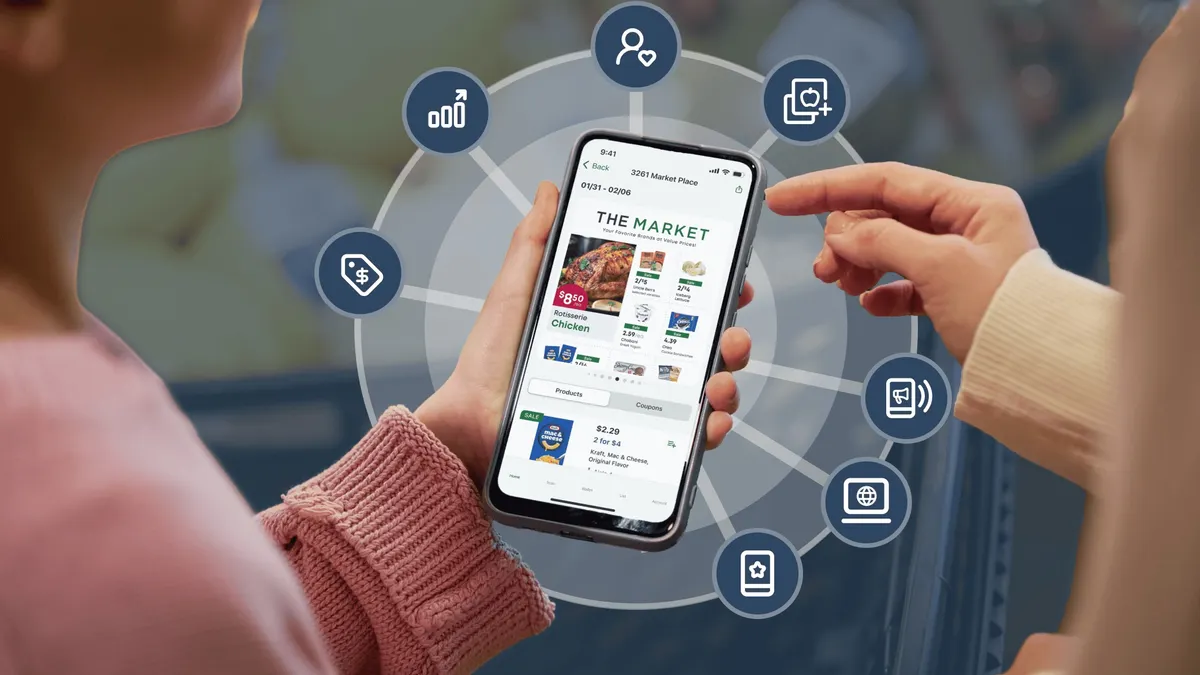
Fragmented tools can’t answer either demand well. Unified platforms—connecting web, mobile app, loyalty, circulars, offers, retail media, and measurement on a shared data foundation—are emerging as the structural response.
What platform adoption looks like in practice
The shift is visible across the regional grocery landscape. Grocers are implementing consolidated digital capabilities—whether through proprietary builds, strategic partnerships, or platform adoption—to close the gap with national competitors. The common thread is a move away from assembling disconnected vendors and toward integrated systems that treat loyalty, media, and commerce as parts of a single ecosystem rather than separate line items.
One of the clearest illustrations comes from Save A Lot. As one of the largest value-focused grocery retailers in the U.S., Save A Lot operates a predominantly independent retail model—balancing national scale with local execution. Like many regional organizations, it faced the challenge of delivering modern digital experiences while maintaining operational simplicity.
Before partnering with Swiftly, Save A Lot was still early in the adoption of digital touchpoints and was looking for a unified way to reach customers across channels. As the retailer expanded beyond traditional circular distribution and in-store promotions, it needed a scalable approach to reach shoppers more effectively. Swiftly’s platform enabled Save A Lot to introduce a native mobile app and launch its first integrated loyalty program within a single connected ecosystem. By bringing these capabilities onto one platform, the retailer was able to create a more consistent shopper experience while gaining clearer visibility into what was driving store trips, basket size, and overall sales performance.
“Moving to a unified platform fundamentally changed how we think about digital engagement. Instead of managing disconnected tools, we’re now able to activate our weekly circular, loyalty program, and media investments together—giving us clearer insight into what drives results and allowing us to move faster across the business.”- Katie Kobus, Vice President of Marketing, Save A Lot
Circular reinvented, loyalty accelerated
A core component of Save A Lot’s platform strategy has been the use of Swiftly’s AI-powered solution, Audience Optimizer™, which helps retailers target and distribute promotions across digital channels with great precision. Because targeting, activation, and measurement all live within the same Swiftly platform, Save A Lot has been able to leverage loyalty data and geo-location signals to reach both known loyalty shoppers and consumers who had recently visited a store location—meeting shoppers closer to moments of purchase intent.
The impact becomes particularly visible during the holidays, when retailers need to amplify promotions and reach shoppers quickly amid intense competition for trips and basket share. Extending circular offers through targeted digital distribution allows retailers to engage significantly more shoppers than traditional print for a comparable investment. In one recent holiday activation, Save A Lot leveraged Audience Optimizer™ to generate nearly $38 in sales for every $1.00 invested, contributing millions in incremental store sales. Based on industry-average print distribution costs, reaching the same audience through traditional print distribution would have cost this retailer 19 times more—and still provided no way to measure whether a single dollar drove results. Digital campaigns also deliver a critical advantage: closed-loop attribution that connects media exposure directly to in-store transactions. It also added thousands of new loyalty members and app users, which drives the flywheel of retail media.
In parallel, Save A Lot has made its loyalty program a cornerstone of its digital approach. The Save A Lot Rewards app, built and powered by Swiftly, serves as the primary digital touchpoint for engaging shoppers, bringing together personalized offers, weekly circular content, loyalty rewards, and digital value in a single experience. Rather than syncing data across systems after the fact, shopper behavior, offer activation, and in-store purchases are connected natively, allowing insights to inform decisions in near real time. This kind of mobile-first engagement is increasingly important as younger shoppers, particularly Gen Z, approach grocery shopping through a digital lens. Industry research shows many Gen Z shoppers begin their grocery journey through a retailer’s mobile app or website [1], and with more than 80% of Gen Z consumers using mobile grocery apps, retailers are increasingly investing in digital touchpoints that meet shoppers where they already engage.
Since the launch of its loyalty program in September 2024, Save A Lot has seen a 125% increase in loyalty registrations. And in 2025, the Save A Lot Rewards app was recognized by Newsweek as one of America’s Best Loyalty Programs—a distinction that reflects not just participation, but the usability, relevance, and consistency of the experience from a shopper’s perspective.
The three-sided value equation
Save A Lot’s experience reflects a broader structural change underway in grocery. Today’s digital ecosystem must simultaneously satisfy three constituencies: shoppers who expect relevance, ease, and personalization across every touchpoint; retailers who need incremental revenue and operational efficiency rather than more systems to manage; and brands who require transparency and proof that marketing spend drives real sales.
Point solutions can address individual needs, but they rarely satisfy all three at once. Unified platforms change the equation by reducing technical fragmentation, simplifying operations, and making measurement trustworthy—aligning consumer experience, retailer execution, and brand accountability within a single environment. That alignment also enables emerging value formats, such as digital cashback and personalized incentives, that influence purchase behavior while preserving shelf pricing and margin.
What comes next
The most important shift here isn’t that grocery technology has improved—it’s that access has fundamentally changed. Advanced digital capabilities are no longer reserved for the largest chains. With the right platform, a 200-store regional can activate the same loyalty, media, and measurement capabilities that were once the exclusive province of the top ten.
That has real implications for how the industry evolves. As retail media dollars continue to flow toward grocers who can prove closed-loop incrementality, retailers without unified measurement will find it increasingly difficult to compete for brand investment—regardless of their store count. The grocers who move first won’t just capture short-term revenue; they’ll establish the data foundations and shopper relationships that compound over time.
What’s unfolding across regional grocery isn’t a temporary advantage. It’s a structural reordering of who gets to compete—and on what terms.
Ready to explore the platform experience? Contact Swiftly today.