Dive Brief:
- Walmart U.S. recorded just over $285 billion in net sales for its grocery segment for its fiscal year 2026, which ended Jan. 31 — a 3.4% increase over the prior fiscal year — according to the company’s newly released annual report.
- That segment accounted for 59% of the retailer’s total U.S. net sales of nearly $483 billion, a decline of less than half a percentage point from fiscal 2025.
- The latest sales figures underscore the vital role food and beverage sales continue to play in driving Walmart’s financial performance.
Dive Insight:
While Walmart continues to record growth in its grocery sales, that pace has slowed in recent years. The roughly 3% year-over-year growth in fiscal 2026 follows the metric rising 4% and 11% in the prior two fiscal years, respectively.
Walmart recently highlighted to the investor community how food remains a vital category for the company amid a challenging economic environment for consumers.
“Wallets have been stretched. If they get stretched further, people are still going to look for value. They're still going to want to eat. Food is the largest thing that we sell,” CFO John David Rainey said on April 8 during the J.P. Morgan Retail Round Up Forum.
Food is playing a key role in the retailer’s store remodeling efforts. The company announced earlier this month that remodeled Neighborhood Market stores will get expanded deli and hot bar selections. Walmart also recently announced plans to redesign its Great Value private label brand, which encompasses nearly 10,000 grocery and consumer items.
General merchandise — Walmart’s second-largest category behind grocery — posted sales growth in fiscal 2026 after slipping for the past three years. Sales in health and wellness, which comprises about 14% of Walmart U.S.’s net sales, increased by about 12%.
Grocery, Walmart’s largest category, continues to grow sales
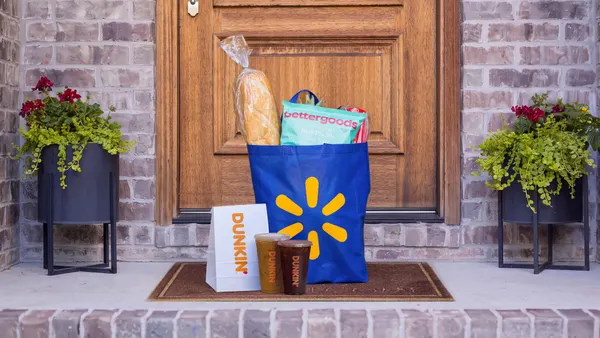
Walmart noted in its annual report that e-commerce sales in the U.S. have steadily increased in recent years. Online sales hit $99.6 billion in fiscal 2026, up nearly 23% year over year. Walmart does not break down grocery sales by in-store and online purchases.
Walmart’s slowing grocery sales growth comes amid a slight decline in its overall grocery market share, according to Numerator data.
For the 12 months ending March 31, the mass merchant recorded 19.9% grocery market share, down slightly from the 20% and 20.4% shares it recorded, respectively, for the same period last year and two years ago. Even with the dip, though, Walmart continues to have an outsized share of food and beverage sales. Kroger and Costco each have just over an 8% share while Albertsons and Publix hover just above 4%.
At Walmart-owned Sam’s Club, grocery net sales totaled nearly $65 billion in fiscal 2026, up 5.6% from fiscal 2025. Grocery accounted for nearly 70% of the club retailer’s net sales in fiscal 2026.