Number Sense is a regular column that uses data to help understand the grocery landscape.
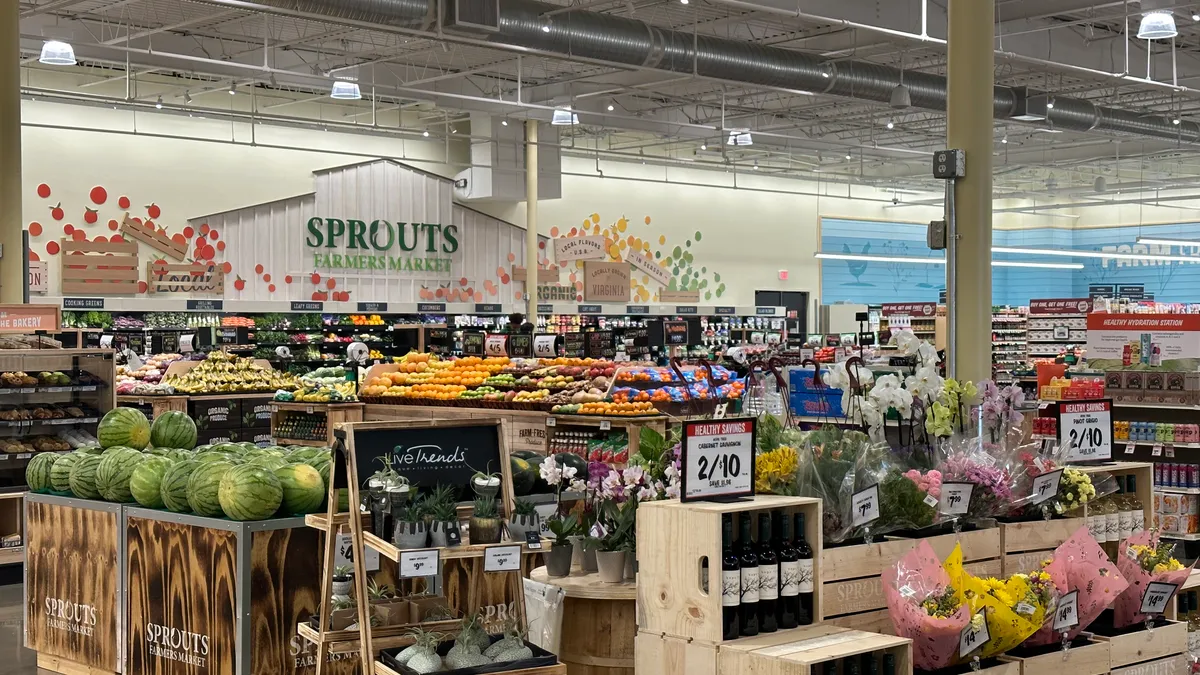
This time last year, Sprouts Farmers Market was flying high — so high, in fact, that investors were giving the specialty grocer the kind of treatment you might associate with a tech company, not a food retailer.
As I noted in this column exactly a year ago, Sprouts had emerged as something of a wunderkind in the grocery world, delivering heady financial results that seemed — for a time, at least — impermeable to the forces that were holding back other grocers.
While conventional supermarket chains were turning in comparable-store sales in the low single digits, Sprouts’ progress by that critical measure had soared to almost 12%, a head-turning figure in an industry where slow sales growth is the norm. Sprouts also won accolades from shareholders and analysts for its sharp focus on wooing shoppers more concerned with buying healthy foods than on saving money, an approach that helped accelerate its top- and bottom-line performance to stellar levels.
Sprouts’ shares have been sinking
Wall Street rewarded Sprouts handsomely for its feats, as shareholders drove its stock price up by almost 24% just in the first half of last year. That ride included some sharp gyrations that in retrospect might have been a sign that shareholders thought the company’s rapid increase in value was built on a fragile foundation. But coming on the heels of a breathtaking rise in the company’s shares of more than 700% over the previous several years, the ascent helped solidify Sprouts’ reputation as a grocer that was setting the pace.
As the company’s latest quarterly earnings report last week put into stark relief, however, Sprouts’ bull run is over. The grocer’s comps have declined steadily after topping out at 11.7% during the first quarter of 2025, sinking to just 1.6% in the fourth quarter, Sprouts said last Thursday.
That news followed Sprouts’ stunning disclosure last October that its quarterly same-store sales growth had plummeted to 5.9% from more than 10% during the prior quarter. Clearly shell-shocked by the emerging evidence of the company’s decelerating sales momentum, investors hammered Sprouts once-highflying stock, which fell by 25% on Oct. 20, 2025, the day after the announcement.
Sprouts’ same-store sales are sagging
Sprouts share price is down by almost 60% since topping $173 in early May 2025, although it is up by more than 6% over the past month.
Another troubling sign for Sprouts is that its same-store sales have declined so precipitously at a time when traditional supermarket operators like Kroger, Albertsons and Ahold Delhaize all turned in better comps during their most recent quarters.
Of course, while strong comps are an indicator of growth in grocery, they can also lay the groundwork for future signs of decline for a retailer if factors that drove sales ahead go away — and that seems to be one aspect of what’s ailing Sprouts.
During Sprouts’ fourth-quarter earnings call last Thursday, CFO Curtis Valentine indicated that the company is finding it harder than it had expected to sustain the momentum it had grown used to. He also noted that the company benefited last year from temporary drivers such as skyrocketing egg prices and the King Soopers strike in Colorado.
Sprouts could have done a better job of making it clear to investors in the past that it was heavily reliant on one-time factors to drive its sales. Arun Sundaram, senior vice president of CFRA Research, pointed out that investors had been trying to figure out whether Sprouts had developed a model that would allow it to maintain the strong growth it had been seeing, or if it had been depending on favorable conditions that were unlikely to repeat. In retrospect, it would have been better for Sprouts to have called out the fact that the latter was the case when it was soaring than to wait until it ran into trouble to do so, he told me.
Another issue that Sprouts is dealing with is that it has leaned heavily on shoppers more concerned with buying healthy foods than saving money. But as CEO Jack Sinclair noted on the call, even those people are feeling the pinch of higher prices and looking for ways to cut costs, putting pressure on Sprouts.
“[O]ur customers are saying to us, ‘Look, we really love your business. We really love what you do. But can you help us a little bit on … affordability?’” Sinclair explained.
Sundaram told me, however, that he thinks Sprouts has struggled to show consumers that its stores are places to find good deals, compounding the challenges the retailer is now facing. In addition, Sprouts is now looking at the need to direct resources toward lowering prices, which is likely to put pressure on its earnings.
“They’re lapping strong growth at the same time that they’re also experiencing some weakness amongst their customer base,” he said. “A lot more customers now are leaning more towards value, and Sprouts hasn’t been able to deliver on the value that you can find at other retailers.”
Sprouts has successfully reversed slumping comparable-store sales in the past. In 2021, the company found itself dealing with underwater comps that were down by as much as 10% as it came off the sharp sales growth it experienced in the previous year during the COVID-19 pandemic. By early the following year, Sprouts was again on the rise.
The company’s guidance for the coming months suggests that a turnaround might be tough to achieve this time around. Sprouts said last week that it expects comps during its current quarter to be down by as much as 3%, and it is looking at the possibility that its same-store sales will be down for all of fiscal year 2026.
As a specialty retailer with a specialized assortment, Sprouts should be well-positioned to find ways to stand out even when times get tough. Does it have what it takes to stage another recovery?