Number Sense is a regular column that uses data to help understand the grocery landscape.
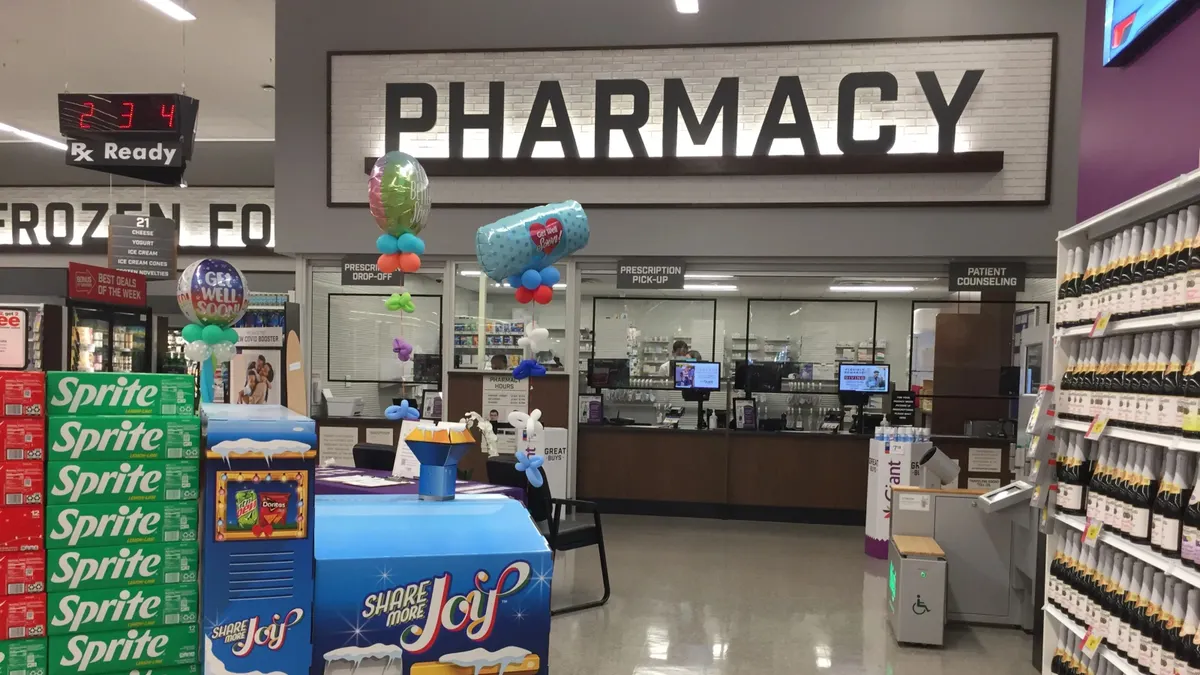
Pharmacies have long been a staple in American supermarkets, and for good reason: They bring shoppers into stores and help encourage grocery purchases as people walk the aisles to pick up prescriptions. Grocers also benefit by encouraging consumers to associate their brands with well-being, which can help them stand out in an increasingly cutthroat retail landscape.
But while the virtuous connection between medicine and food provides unmistakable advantages to the grocery sector, pharmacy — a key department that has historically helped drive sales growth — is morphing into a headwind. A central reason for the tension is a Biden-era law designed to hold down drug prices that is now coming into effect and crimping supermarkets’ pharmacy revenue.
The implementation of that law, the Inflation Reduction Act, is shining a bright light on how heavily grocers have come to depend on their pharmacies in recent years to demonstrate growth.
Albertsons, for instance, reported in January that strong pharmacy sales growth during the third quarter of fiscal 2025 was the main factor behind its 2% year-over-year comparable-store sales growth. But in April, Albertsons had a much different story, as unexpectedly heavy pressure posed by the Inflation Reduction Act squeezed its pharmacy business and was a key culprit in driving its fourth-quarter comps down to below 1%.
Even more ominously, Albertsons said it expects its same-store sales for all of fiscal 2026 to be at or close to flat, blaming the uninspiring outlook on the pharmacy reimbursement pressures it is facing.
Other grocers have also recently pointed to the Inflation Reduction Act as a source of pain. Weis Markets said earlier this month that pharmacy sales declined during its first fiscal quarter, even as overall revenue increased almost 5%. Publix also said this month that its sales were held back by the drug price law.
Notably, some grocers have moved away from the pharmacy business after concluding that they didn’t want to navigate the complex economics of selling medicine. For example, Schnuck Markets transferred nearly 100 pharmacy locations to CVS in 2020, and Lunds & Byerlys announced plans to close all of its pharmacies in the Minneapolis area in 2019.
Signed into law by former President Joe Biden in August 2022, the Inflation Reduction Act requires the Department of Health and Human Services to negotiate prices with pharmaceutical manufacturers for drugs the government purchases for Medicare participants. Negotiated prices for 10 drugs, including diabetes medications Jardiance and Farxiga as well as blood thinner Eliquis, took effect this year.
Grocers should be especially wary of the fallout they may face in 2027, when prices the federal government pays for 15 more drugs fall under the purview of the law, because that group includes the blockbuster GLP-1 medications Ozempic and Wegovy.
As John Clear, a partner at consulting firm AlixPartners, pointed out to me, GLP-1s — which have had a profound impact on how people buy groceries and are growing quickly in popularity — have helped pump up grocers’ top lines because of their high prices, even though they are not in themselves sources of profits for food retailers. That suggests that further pressure on how much grocers actually get paid for dispensing GLP-1s could become problematic for the grocery industry.
Compounding matters, the changes to pharmacy reimbursements come as grocers’ reliance on pharmacy to generate sales growth has intensified.
In 2020, for example, pharmacy accounted for 7.4% of Albertsons’ total sales. That figure has increased steadily since then and reached almost 14% in the company’s latest fiscal year.
In addition, while Albertsons’ overall revenue in fiscal 2025 of $83.2 billion was 19% higher than the comparable figure for fiscal 2020, pharmacy sales more than doubled over the same period, underscoring the critical importance of its pharmacy business.
Kroger has been on a similar trajectory. The chain’s total sales were up about 11% between fiscal 2020 and fiscal 2025, to about $148 billion. By contrast, Kroger’s pharmacy sales sped ahead by almost 60% during that period.
According to Kroger, pharmacy, digital and fresh sales were central components of its fourth-quarter comps, which came in at 2.4%. We’ll need to wait until the chain releases its first-quarter earnings next month to see how its latest results might have been impacted by the law.
The road ahead for grocers promises to get steeper, as the Centers for Medicare and Medicaid Services plans to start negotiating what it pays for 15 additional drugs in 2028.
While the pressure grocers are feeling from the Inflation Reduction Act is just getting underway, more than four years have passed since the law went into effect. That raises some essential questions: If grocers had so much notice that their pharmacy sales could face headwinds beyond their control, could they have prepared for the possibility of stormy weather sooner? And why have they been increasingly reliant for sales growth on a department that has faced so much potential for turmoil?