Dive Brief:
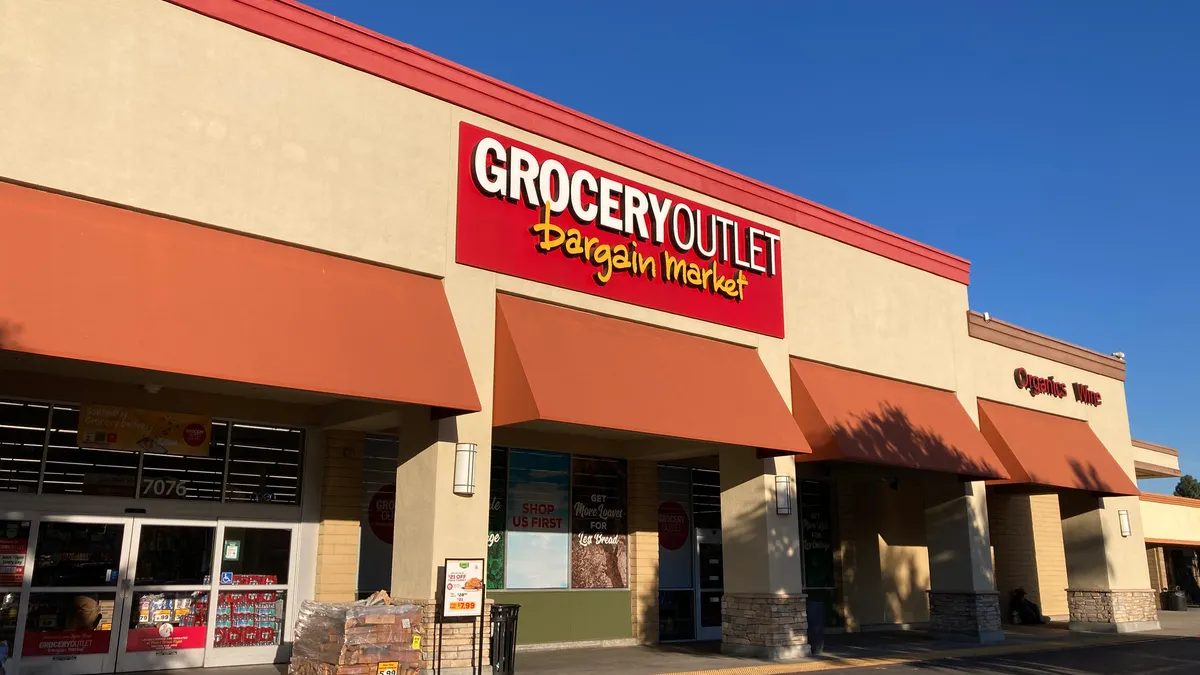
- Grocery Outlet announced it is closing 36 underperforming stores — 6% of its store fleet — amid dismal fourth-quarter results that saw a nearly $235 million operating loss and a more than $218 million net loss.
- Two dozen of the closing locations are on the East Coast, representing 30% of that region’s store count, President and CEO Jason Potter said on a Wednesday earnings call, noting that the company’s other 51 East Coast stores are profitable.
- “We are not fully exiting any state, and we believe we have a meaningful opportunity to grow in the East over the long term, however, it’s clear now that we expanded too quickly,” Potter said.
Dive Insight:
The store closures follow a challenging few months for Grocery Outlet as the discounter struggles to regain its financial footing.
During its last earnings call, the grocer detailed how it was leaning on a store remodeling program that gives locations a standardized format, new C-suite hires and new product ordering guides for its independent operators to help bolster its financial performance.
In November, though, the discounter experienced a double-digit decrease in EBT sales amid the temporary lapse in SNAP funding, company executives said on Wednesday’s earnings call. Amid the highly promotional holiday period, comparable-store sales decelerated in December and then “bottomed out” in January, CFO Chris Miller told investors.
At the end of last year, pressure on Grocery Outlet’s core consumer increased more than expected, and by January, the discounter was seeing declining units per transaction and slowing traffic growth, Potter said. For Q4, which ended Jan. 3, Grocery Outlet saw net sales increase nearly 11%, to $1.2 billion, but comparable-store sales slipped by nearly 1%.
“Our fourth-quarter results were unacceptable, and our outlook for 2026 reflects a business that has more work to do than we expected,” Potter said. “I own this and own fixing the issues.”
A review at the start of the year identified three main issues behind the comps deceleration, Potter said. Along with the intensified pressure on consumer spending, the discounter discovered that its “value perception had eroded” even as its base pricing remained competitive. In addition, its efforts to improve in-stocks and add assortment squeezed its supply chain too tightly, he said.
“Shoppers came in looking for the value and the treasure hunt experience they expect from Grocery Outlet, but left with fewer items per trip because we didn’t deliver the weight of WOW [deals] and the breadth of assortment that drives basket size and value,” Potter said.
The three dozen store closures are part of an optimization and restructuring plan, for which the company forecasts it will incur between $14 million and $25 million in net total restructuring charges in fiscal 2026. The discounter also expects to take a $4 million- to $6 million-hit to its 2026 gross profit due to discounts and markdowns to liquidate inventory at closing stores.
“Once completed, we expect these closures will result in annualized adjusted EBITDA improvement of approximately $12 million. This should enable us to operate more profitably across our markets going forward while focusing our financial and operating resources where they can earn the strongest returns,” Miller said.
While Grocery Outlet is closing approximately 6% of its store fleet, the discounter isn’t halting its expansion plans. During Q4, Grocery Outlet opened seven stores, ending the quarter with 570 locations in 16 states. For fiscal 2026, the grocer plans to open between 30 and 33 stores, taking a “clustered model to improve supply chain efficiency and marketing leverage,” Potter said.
Meanwhile, the discounter is charging ahead with store remodeling, with plans to refresh 150 locations in 2026.
In fiscal 2025, Grocery Outlet saw net sales rise by 7.3%, to just shy of $4.7 billion, and comp sales increased by half a percentage point. The company recorded a nearly $222 million operating loss and a nearly $225 million net loss.
For fiscal 2026, Grocery Outlet expects to achieve $4.6 billion to $4.7 billion in net sales and comp sales between -2% and 0%.
Grocery Outlet’s shares fell Wednesday to an all-time low of $8.79 ahead of its earnings release. Investors reacted sourly to Grocery Outlet’s results, driving down the company’s stock price by more than 20% in after-hours trading following the release of the earnings report.
Grocery Outlet went public on June 20, 2019, with its stock price finishing that day at $28.51.
Sam Silverstein contributed reporting.