


Walmart Inc. was still formally named Wal-Mart Stores, Inc. when Doug McMillon was appointed CEO over a decade ago.
Since then, the mass retailer has changed in more ways than just its name. Under McMillon’s leadership, the company’s technology and e-commerce investments have grown, and top-line performance metrics have soared.
But McMillon’s time as CEO has now come to an end — and it’ll be a tough act to follow. However, McMillon has sounded upbeat about company veteran John Furner’s ability to lead the retailer into the next age of digital change with the emergence of AI.
McMillon set the stage in that regard already. His professional accomplishments stem from his strategic adoption of technology, according to industry experts.
When McMillon’s retirement was announced in 2025, industry analysts remarked both on his business acumen and his charisma with people.
“In addition to transformational digital impact, he had a deep connection to stores, people, & communities,” TD Cowen analysts led by Oliver Chen said in a note from November after the announcement.
Change was happening in the retail industry when McMillon was tapped as CEO back in 2013 — as noted by chairman of the board of directors, Rob Walton, at the time — and change has continued to be a common theme for the company ever since.
The retailer’s willingness to change was reiterated by Furner during The National Retail Federation’s Big Show in January when discussing the impacts of AI.
With Walmart eyeing its next era, here's a look back at how McMillon’s leadership got the retail giant to this point.
Profitability skyrockets
Walmart Inc.'s net sales increased 43% under Doug McMillon's leadership
Walmart reported its fiscal year 2014 net sales reached about $473 billion, while net income was $16.7 billion. Now, over a decade later, McMillon’s leadership has helped grow those metrics by about 43% and 21%, respectively, per its latest 2025 annual report.
Walmart Inc.'s consolidated net income grew 21% under Doug McMillon's leadership
But change can also be seen outside the retailer’s top-line financial performance.
Across the globe, the retailer in 2014 served 250 million customers weekly in stores, with about 2.2 million associates and 10,942 stores.
For its 2025 fiscal year, Walmart said it had about 270 million customers weekly across the business, with 2.1 million associates and slightly fewer store units (10,771).
“I think Doug McMillon was a terrific CEO,” Joe Feldman, analyst at Telsey Advisory Group, told sister site Retail Dive. “He's a good people person, and I think people within the company and outside the company have responded quite well to him, and he was able to make an impact strategically in terms of really overhauling the thinking and the mindset behind Walmart and the culture.”
That strategic shift relied heavily on McMillon embracing technology and e-commerce.
A digital bet pays off
Walmart Inc. increased the share of its investments that went toward technology and e-commerce over the years
Walmart’s 2014 e-commerce sales, including acquisitions, totaled over $10 billion, representing a 30% increase at that time, per the company’s shareholder letter from McMillon.
“A strong focus on e-commerce is now fully embedded within each of our businesses and we’ll increase our investment as e-commerce opportunities present themselves,” McMillon said in the letter.
Compared to Walmart's e-commerce reach today, that number seems almost minuscule. The mass retailer for fiscal 2025 reported $121 billion in e-commerce sales, representing a 1,110% increase from 2014.
The tech and e-commerce focus can be seen through the company’s annual capital expenditure allocations. The retailer breaks down its annual total capital expenditures into a few categories, one of which has changed in description over the decade, but has always encapsulated Walmart’s investment in technology and e-commerce, as well as areas such as supply chain.
Back in 2014, Walmart invested about $2.5 billion towards “information systems, distribution, e-commerce and other,” whereas a majority of the total expenditures for the year went toward opening new stores, as well as expanding or relocating existing locations.
In comparison, in fiscal year 2025 Walmart spent about $14.6 billion on what it now describes as “supply chain, customer-facing initiatives, technology and other.” This makes up about 60% of its total expenditures for the year.
“Mr. McMillon's expensive but, essential commitments to tech innovation are paying off,” TD Cowen analysts noted in November.
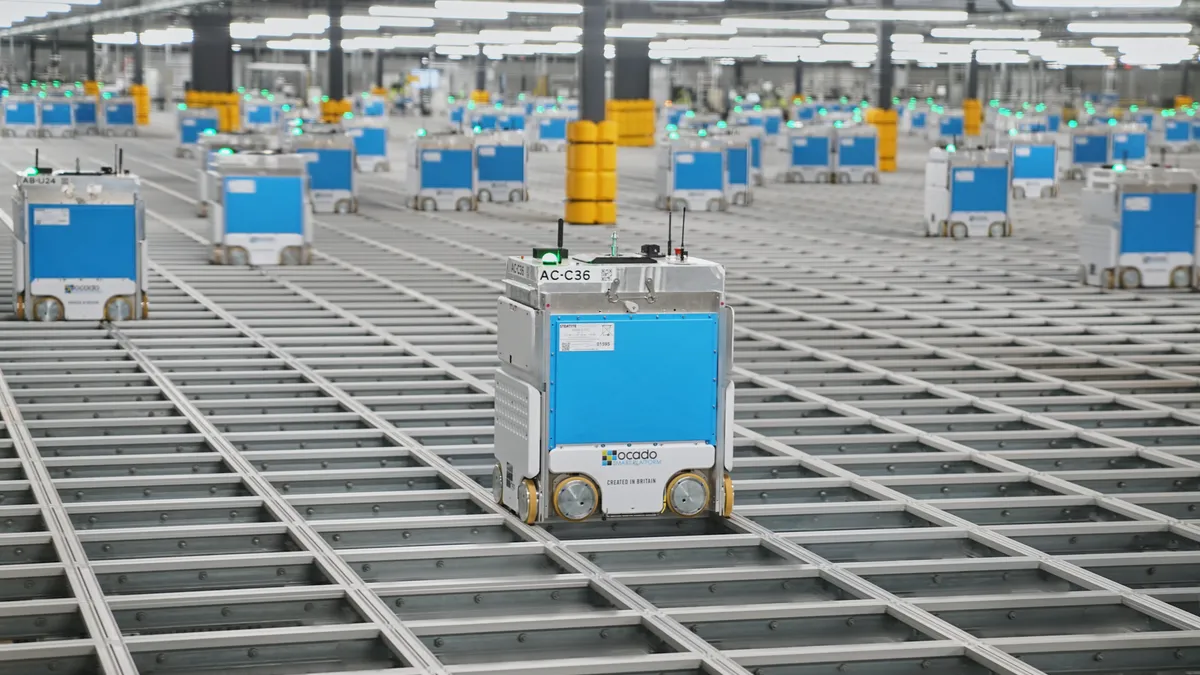
Walmart over the past decade unified its digital app suite, debuted its Walmart+ paid membership, invested heavily into distribution center automation, and more.
“Customers are channel agnostic – shopping in stores, online or with their phones is more seamless than it used to be,” McMillon said in a 2015 shareholder letter. “We’re thinking the same way.”
A commitment to that level of corporate transformation is rarely seamless, according to Professor of Management Tammy Madsen from Santa Clara University’s Leavey School of Business.
“I think every major transformation of this kind of scale has friction,” Madsen told Retail Dive. “There's periods of margin pressure, fulfillment complexity and building scale against a competitor like Amazon — that's not easy. And so I think what we see is McMillon committed to change and to invest to address what was needed, rather than retreat.”
McMillon’s acquisition strategy and willingness to test out new capabilities also played into Walmart’s tech evolution.
Experimentation and acquisition
McMillon embarked on several acquisition efforts as CEO of Walmart — some of which yielded significant success while others served as lessons for the company.
Among the notable wins was the retailer’s investment in Indian e-commerce company Flipkart in 2018. It was both a bet on e-commerce and on international expansion for the retailer. Since then, Walmart also invested in the Indian fintech platform PhonePe.
The investments have been largely successful for Walmart, Feldman said, adding that both companies have attractive equity valuations.
Walmart has continued to test new efforts with McMillon serving as CEO, particularly through its international markets, as noted by outgoing President and CEO of Walmart International Kathryn McLay during a Q3 earnings call in October. The retailer, for example, has been testing its “Carrito Listo” agentic WhatsApp capability in Chile.
Another notable investment for McMillon was Walmart’s $3 billion acquisition of online retail company Jet.com in 2016. While the company has since wound down the Jet operations, the retailer previously said it was critical to evolving its omnichannel operations.
“Everybody thought that was a crazy acquisition,” Feldman said. “Looking back in hindsight, it looks really smart, because what he gained from that was it helped leapfrog Walmart's thinking about e-commerce and how to integrate e-commerce and how to really embrace the way people were shifting and pivoting in terms of their shopping towards not just online, but a hybrid of online plus physical.”
Not all of the retailer’s acquisitions have been quite as clear-cut, however. Walmart snapped up several DTC and specialty businesses over the years, including Moosejaw, Eloquii and Bonobos — which were then sold off over time.
The moves, however, did provide learnings and executive talent for Walmart, including Andy Dunn of Bonobos and Marc Lore of Jet, though both have since left the retailer. The acquisitions also helped Walmart attract new customers and showed that McMillon had the humility to pivot when needed, according to Feldman.
Taking on hiccups along the way were also part of the “long march” of transformation that McMillon committed to during his tenure, as Santa Clara University's Madsen described it.
“Few legacy CEOs in the retail space have successfully navigated this shift from kind of a store-centric approach to an omnichannel at this scale,” Madsen said. “I think he was able to do it because he embraced technology as a core capability, not just as a support function.”