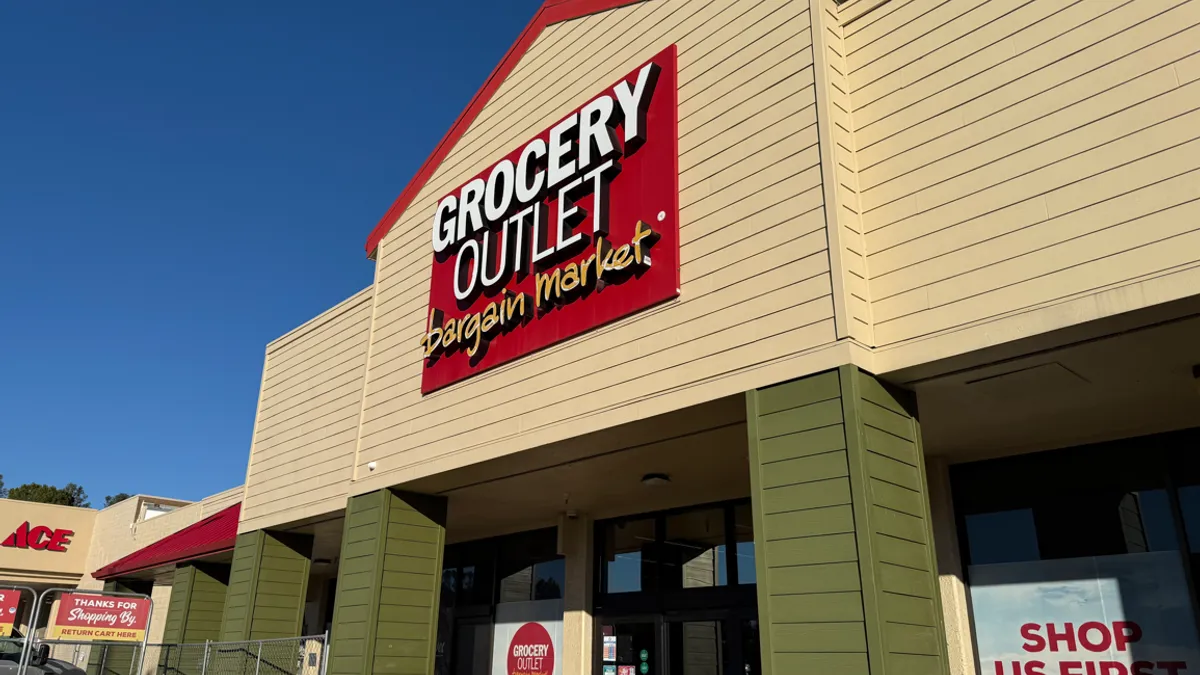
Grocery Outlet divulged during its fourth-quarter earnings call last week that it’s closing 36 underperforming stores, marking a significant setback for the fast-growing discount retailer.
The grocer didn’t specify at the time specifically where it plans to close stores, noting only that 24 of them are on the East Coast. But shortly after the news came out, Gordon Brothers, a global advisory, restructuring and investment firm that is working with Grocery Outlet to market the stores, listed all of the locations that are up for sale.
On the East Coast, the closures include eight stores in Maryland, six in New Jersey, six in Ohio and four in Pennsylvania. Out West, the retailer will close nine stores in California and three in Idaho, per the flyer. The stores range in size from just under 14,000 square feet to 30,000 square feet, with 21 spanning less than 20,000 square feet.
Several shuttering Grocery Outlet stores are in metropolitan areas like Cincinnati and Philadelphia
“We are not fully exiting any state, and we believe we have a meaningful opportunity to grow in the East over the long term, however, it’s clear now that we expanded too quickly,” Grocery Outlet President and CEO Jason Potter said on a Wednesday earnings call.
While Grocery Outlet is closing 30% of its locations on the East Coast, the remaining 51 stores in that region are profitable, Potter said. Based in California, Grocery Outlet started its East Coast operations with the 2011 purchase of Amelia’s Grocery Outlet, a 13-store chain based in Pennsylvania. That chain was rebranded to Grocery Outlet in 2015.
Grocery Outlet has quickly expanded its store count since 2020
The 36 closures account for approximately 6% of Grocery Outlet’s store fleet.
The stores up for sale are “positioned in established neighborhood centers and dominant regional corridors,” and are fully built with customer-ready sales floors, refrigeration systems, back-of-house infrastructure and dedicated parking, Gordon Brothers said in an emailed press release.
“The combination of favorable lease structures and existing infrastructure creates a meaningful capital and speed-to-market advantage for operators,” Al Williams, co-head, North America real estate services at Gordon Brothers, said in a statement.
Earlier this year, the grocer conducted a strategic, financial and operational analysis of its store fleet, which identified the 36 stores that the discounter is closing.
The three dozen store closures are part of an optimization and restructuring plan that Grocery Outlet expects will incur between $14 million and $25 million in net total restructuring charges in fiscal 2026. The discounter is also bracing for a $4 million- to $6 million-hit to its 2026 gross profit due to discounts and markdowns to liquidate inventory at closing stores.
The closures, which the discounter plans to complete in its second quarter, will provide an annualized adjusted EBITDA improvement of approximately $12 million, CFO Chris Miller told investors Wednesday.
Looking to the future
Grocery Outlet plans to conduct a strategic review of discount grocer United Grocery Outlet, the 40-store chain it acquired for roughly $62 million in 2024.
At the time of the purchase, Grocery Outlet said the deal would help it scale into the Southeast. Company leaders, though, indicated last week that the future of the regional chain is up in the air.
“We have confidence in the [UGO] business, the team there, the market — it continues to be profitable and stable, but given our priorities and the trend on the court business, we want to make sure we’re evaluating our options,” Potter said, noting that the company is considering several options ranging from “full integration to a potential sale.”
Even as Grocery Outlet is closing three dozen stores, the discounter is adding more locations to its fleet. The grocer plans to open between 30 and 33 stores in fiscal 2026 and will focus on a “clustered model to improve supply chain efficiency and marketing leverage,” Potter said.
In February, Grocery Outlet made its debut in Virginia with a Falls Church location. The discounter has three more locations on the docket for that state, with stores in Virginia Beach and Portsmouth opening March 12 and one in Williamsburg opening on April 9, according to The Virginian-Pilot.
During fiscal 2025, Grocery Outlet opened 42 stores and closed five.
Grocery Outlet’s store base remains mainly on the West Coast in its home state of California
The discounter is accelerating its store remodeling, with plans to refresh 150 locations in 2026.
The discounter is also shifting its ownership model to have certain stores run by the company before handing them off to independent operators. New stores in Virginia, for example, will start as company-run locations “with the intent of bringing them up to profitability before handing them over to independent operators,” Potter said.
“Once proven, we believe this approach could be applied in more markets as we continue to grow this business,” Potter said.