Dive Brief:
- Kroger has canceled plans to open an automated e-commerce fulfillment center in the Charlotte, North Carolina, area that it had been developing through its partnership with Ocado, the U.K. warehouse automation company disclosed in a filing with the London Stock Exchange on Friday.
- Kroger will pay Ocado $350 million to compensate the technology provider for the grocer’s decision not to proceed with the Charlotte CFC and close the three other CFCs, according to a filing by Ocado.
- Kroger also plans to close a spoke facility in Nashville, Tennessee, in early 2026, according to a notice the retailer filed with state regulators. The grocer plans to lay off 132 workers as a result of the closure, which is due to take effect on Feb. 1.
Dive Insight:
Kroger’s decision not to move ahead with the Charlotte customer fulfillment center and close the Nashville spoke represents its latest steps to reverse course on the ambitious e-commerce automation project it launched with Ocado in 2018.
Earlier this year, Ocado said it would open the Charlotte CFC in 2026 with Kroger along with another CFC in Phoenix. The North Carolina facility would have served a competitive Mid-Atlantic market served mainly by the grocer’s Harris Teeter banner.
Meanwhile, the Nashville spoke, which opened in mid-2022, operates in tandem with Kroger’s CFC in Forest Park, Georgia. Like employees at other spokes, workers at the facility, which is located just outside Atlanta, transfer orders assembled at the CFC to trucks for delivery to customers.
Kroger said last month that it would close CFCs in Wisconsin, Maryland and Florida in January as part of a broader initiative intended to help improve the economics of its grocery delivery business. Kroger has also disclosed plans to close at least three spoke centers in Florida as well as a spoke in Alexandria, Virginia, that falls under its Harris Teeter banner.
The companies plan to “continue to work closely together” to maintain CFCs they jointly operate in Ohio, Texas, Colorado and Michigan as well as the facility in Georgia, Ocado said.
“Ocado teams remain well-embedded within this network of CFCs, supporting significant progress in operational efficiency, volume growth, and increasing same day availability, resulting in a significant improvement in financial performance,” Ocado said in the filing.
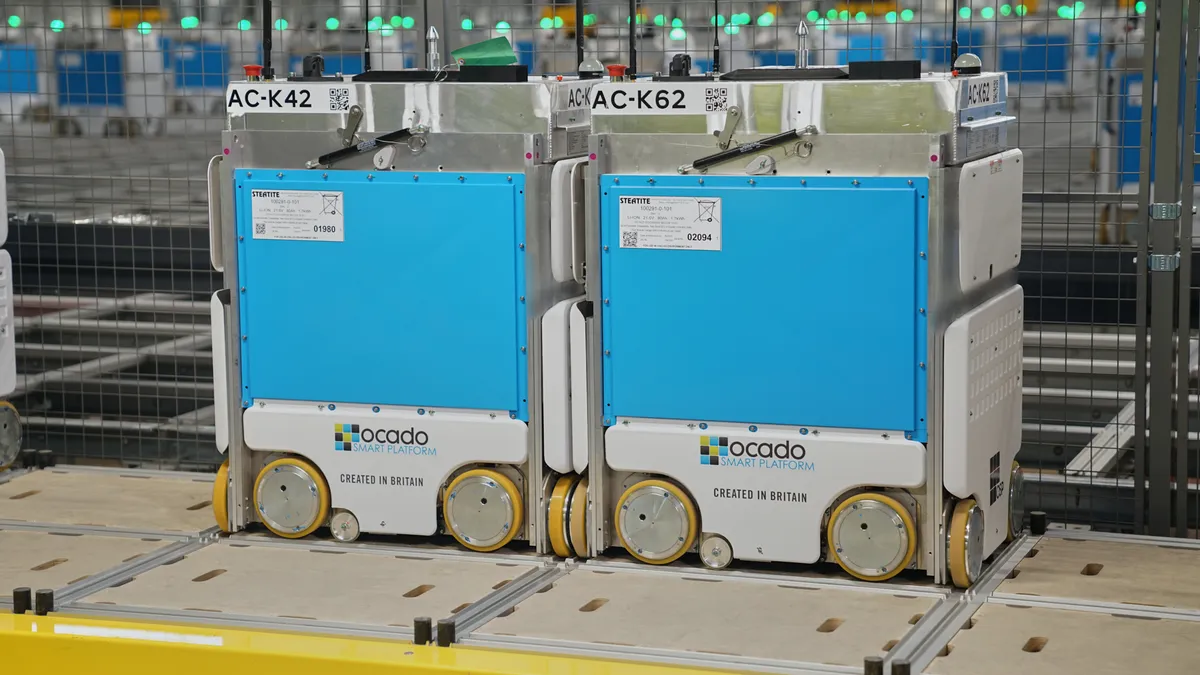
Kroger is also moving ahead with an effort to install technology from Ocado designed to boost productivity and capacity in its fulfillment facilities, according to Ocado. The improvements include an expansion of the capacity of Kroger’s Detroit CFC. Kroger has also ordered gear to further increase the CFC’s capacity and said it plans to use Ocado’s AutoFreezer technology for the first time in the CFC it plans to open in Phoenix, Ocado said.
Kroger has indicated that it needs to rely more heavily on individual stores to assemble orders for delivery customers in order to turn a profit online. Kroger has also stepped up its partnerships with Instacart, DoorDash and Uber as it strives to improve the efficiency of its grocery delivery business.
The company expects that its online operations will begin making money next year, executives said during an earnings call on Thursday.