Like retail media back in 2022, artificial intelligence is the buzziest concept in retail right now.
The rise of AI-powered tools like ChatGPT has led to retailers finding ways to integrate the flashy technology into their own operations. For example, Kroger launched a new personal shopping assistant through an expanded partnership with Google Cloud. Albertsons, meanwhile, is leveraging ChatGPT’s AI capabilities to test out conversational advertising formats to drive better consumer experiences.
But data shows consumers aren’t married to the technology quite yet. According to Dunnhumby’s latest Consumer Trends Tracker, published earlier this month, only 15% of U.S. consumers are using AI tools for grocery shopping, citing trust as the main blocker.
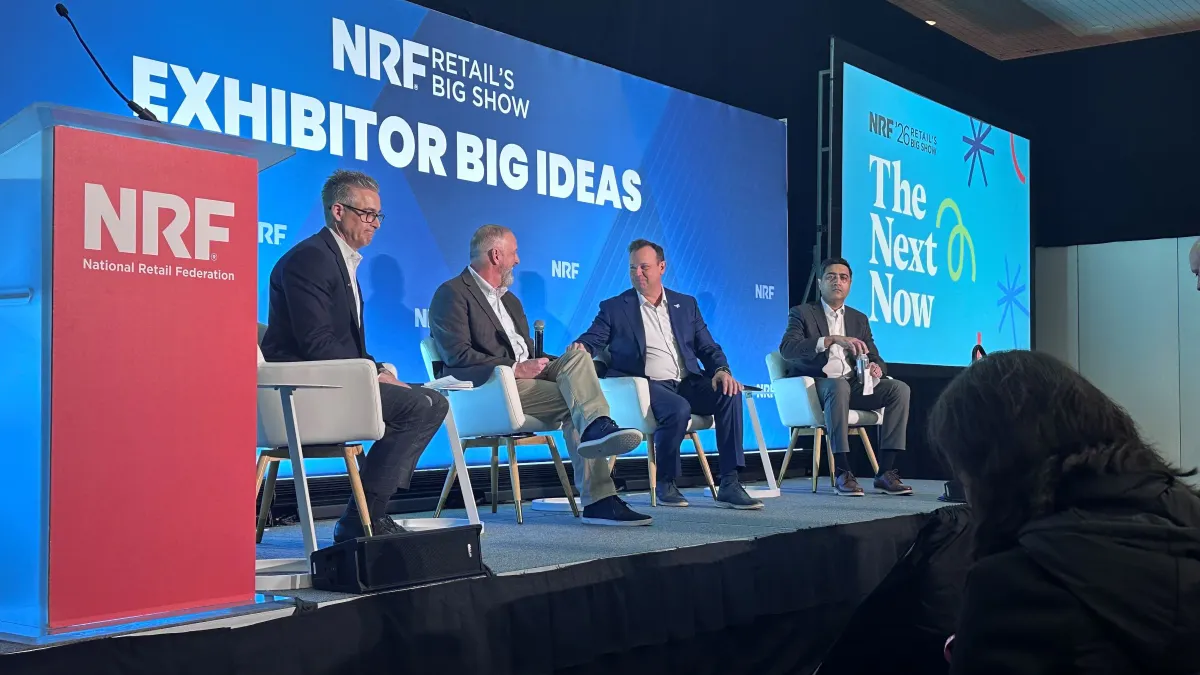
Even so, AI is a must-use technology in order for grocers to remain competitive. Rather than make it more accessible to shoppers, grocers are primarily equipping their store-level associates with this cutting-edge technology — something made clear during this year’s National Retail Federation Big Show in New York City last month.
Grocers will continue to pilot technology that puts AI-powered tools into the hands of shoppers. But retailers’ main focus right now is on advancing store-level AI capabilities.
Improving the employee experience
Grocers like Kroger say they’re using AI to cut through red tape for frontline associates in order to provide an improved in-store shopping experience while also ensuring smoother back-end operations.
Along with its growing partnership with Google, Kroger highlighted Sage, its AI virtual assistant that provides staffers with a single point of access to check their shift schedule, request time off, set shift availability and view their pay stubs. The tool also lets store and regional managers see real-time labor data insights as well as view changes at individual locations.
Kroger isn’t the only grocer finding ways to consolidate employee systems with AI. Hy-Vee Senior Principal Product Manager Becky Olson spoke at NRF about how the regional grocer is using AI in partnership with Workday to streamline store- and department-level operations.
At the store level, Hy-Vee established a single mobile app to replace what was previously a “fragmented” system for accessing important information like payroll, Olson said.
“Employees are really focused on mobile — that was something [that is] really important to them,” she said. “And so when they’re having to log into multiple systems, have multiple logins and download multiple apps, it’s cumbersome for them.”
With the new AI system, store leaders no longer have to jump between systems. Olson noted that schedules that once had to be made from scratch can now be developed entirely with Workday’s AI technology, allowing store managers and department-level managers to simply “go in and make small tweaks and optimize.”
“We wanted to reduce the amount of systems that our employees and our floor leaders were having to utilize to get the data they need and be able to drive the decisions much quicker and more efficiently,” Olson said.
Advancing in-store retail media
In addition to streamlining worker operations, AI has also proven to be very useful in crunching consumer data to aid retail media networks and other functions.
“AI — it makes consumer data at mass so much more… processable,” Kelly Pedersen, a partner at PwC, said in an interview during NRF. “So I think, from a consumer perspective, we’re going to see a lot more personalization than we ever have before in retail media.”
A crucial aspect of a successful retail media network is its ability to process real-time data that grocers can then use to personalize the shopping experience — something that is far trickier with in-store retail media efforts than digital ones, as it’s harder to track shoppers’ moves and decisions in-store.
Generation Z customers are at the intersection of in-store and digital shopping, Pedersen noted, as they are both the biggest drivers of in-store traffic while also being the most digitally advanced.
“[Gen Z] doesn’t necessarily shop in stores, but they like to be in stores. They shop digitally and in-store… So anything from an experiential perspective that improves the experience is what [grocers] are looking for,” he said.
AI also shines on the advertising side of retail media, as the technology can quickly deliver recommendations for custom experiences, Pedersen said. This, in turn, allows advertisers, CPG partners and retailers themselves to simply modify campaigns autonomously created based on consumer data collected.
“So retail media should be more effective, because the optimization cycles can run so much faster with processing all of that bigger data [using AI],” Pedersen said.