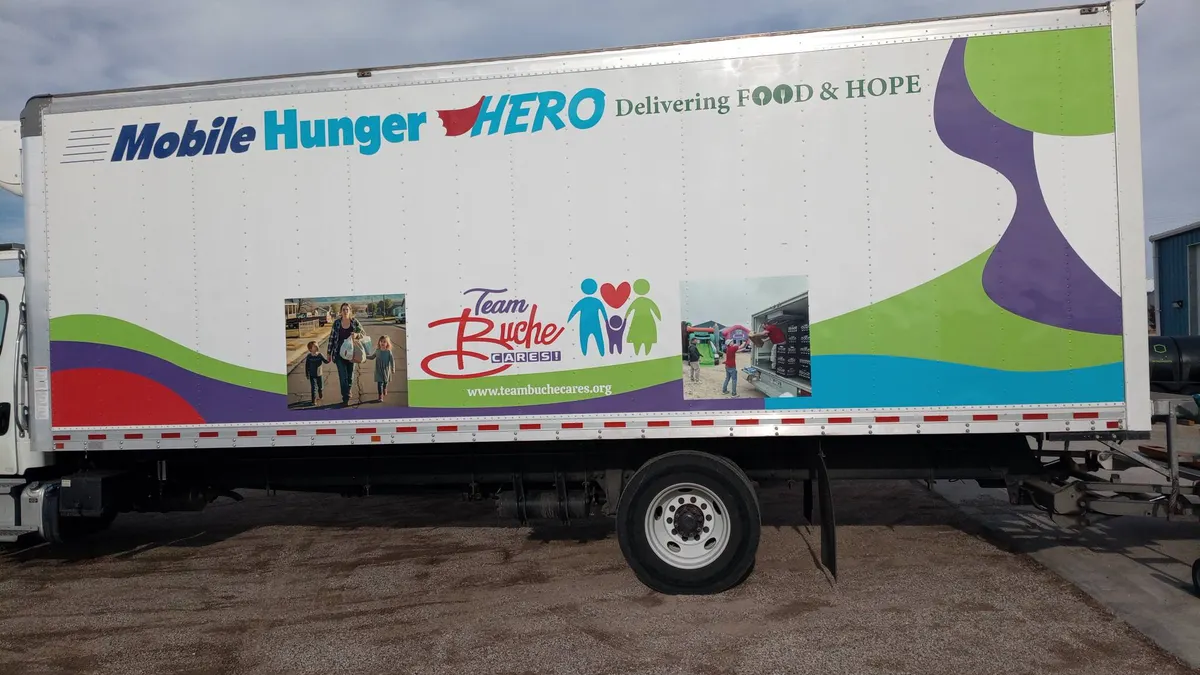
Since December, Buche Foods, a fourth-generation-run grocery chain in South Dakota, has used a mobile food pantry to help bridge food accessibility gaps in its home state, particularly for people in rural and tribal communities.
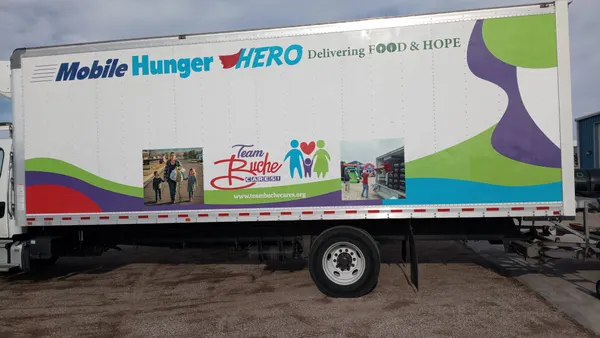
Dubbed the Mobile Hunger Hero, the truck rolled up to Antelope, South Dakota, earlier this month to give out packages of hot dogs, potatoes and eggs. The mobile pantry is “getting food right to the people,” RF Buche, president of GF Buche Company, said in an interview. “One of the things here is that transportation is an issue.”
The mobile pantry serves on an ad hoc basis, with Buche estimating that it’s out in the communities about three times a week, and taps excess inventory from suppliers.
“[Dakota Layers] called me and said, ‘Do you want a truckload of eggs?’ ‘Like, yeah, absolutely,’” Buche said about his conversation with the egg farm in early January. “And so we would go out, and then we take that Mobile Hunger Hero, go right to the people and give them a tray of two and a half dozen eggs.”
The Mobile Hunger Hero has also served up milk, orange juice, pork loin and pastries, Buche said.
“As long as we keep getting product, we’re going to continue to get it out to the people. It’s just the right thing to do, and it feels good to do it,” Buche said.
Mobile Hunger Hero is just one initiative by Buche Foods to meet community needs and fight hunger. Roughly 113,750 South Dakotans are food insecure, of which 35% are children, according to Feeding America data.
“Whatever I can do to try and bridge that [hunger] gap, that's what we want to do,” Buche said. “That’s who we are.”
The engine behind hunger relief
While many grocers partner with nonprofits to help with food distribution efforts, GF Buche Co. has its own charitable arm, Team Buche Cares. The nonprofit not only runs the mobile food pantry, but also hosts events to raise money.
The nonprofit’s annual “Steelers in the Field” charity event, which invites participants to hunt pheasant alongside Pittsburgh Steelers football players, and the “Rooster Roundup” pheasant hunt in the fall both raise money for hunger relief.
At the end of last year, the nonprofit provided $100 food certificates to over 2,900 SNAP households — worth in total nearly $300,000 — during the temporary SNAP funding lapse, Buche said. The grocer raised money to feed 46,260 people a holiday meal, which included a protein, bread, vegetables and dessert.
Taking the temperature on chilled grocery lockers
While Team Buche Cares is the heart of Buche’s work to combat food insecurity, Buche Foods is also testing ways to make grocery delivery more accessible to its customers. The idea stemmed from Buche seeing customers spend upwards of $50 on rides to get to their local grocery store — “That’s money that they could have spent on clothes, they could have spent on laundry detergent or they could have spent on diapers,” Buche said.
Instead of bringing customers to the store, Buche Foods has tried to bring the food to the customers. The grocer used Healthy Food Financing Initiative funds to set up chilled lockers, which can store refrigerated and frozen foods, at a community building in Marty, South Dakota, allowing customers to get their grocery orders delivered to the lockers without a delivery fee, Buche said. The grocer selected Marty because it’s close to the grocer’s headquarters, making it easier to monitor how the initiative goes.
Ahead of rolling out the lockers, Buche Foods hosted a dinner in Marty to explain to people how they work and did “quite a bit of social media” about them, Buche said, noting that the grocer also tested the lockers before making them live.
The grocer has since run into a different accessibility hurdle, though — having someone at the community building who can let people in.
“I still think these lockers do make sense,” Buche said, noting the grocer hasn’t figured out its next steps. “I do think that these lockers [paired] with our online ordering, they do have some merit in some very rural places.”
Generations of giving
The grocer’s efforts to fight food insecurity not only showcase the powerful relationship between grocers and the communities they serve, but also the inherited culture of a family-run business.
“I’ve been in these grocery stores my entire life,” said Buche. “It’s all I've ever wanted to do.”
Buche recalled one time he was with his dad at a Buche Foods store in Gregory, South Dakota: “There was a young mom in there, and she was checking out her groceries, and she didn't have enough money, and my dad went over and quietly paid the bill so that mom could put food on her family’s table that night,” Buche said. After she left, his dad told him, “‘When you’re in this business, it is your moral obligation to make sure no one goes hungry,’ and I have never forgotten that.”