
For years, the conversation around grocery eCommerce focused heavily on the digital experience. Retailers invested in websites, apps, ordering platforms and delivery partnerships to make online grocery shopping easier.
Today, the challenge is evolving.
Online grocery is becoming a more established part of how consumers shop, and expectations around fulfillment are changing with it. Speed, convenience, and choice are increasingly shaping where consumers place their orders. For grocery retailers, that means the next phase of eCommerce investment cannot focus exclusively on what happens on the screen. It also needs to address what happens behind it.
eGrocery is entering a new phase
Recent research from Brick Meets Click illustrates just how quickly the market is changing.
In its June 2026 analysis, eGrocery’s Hyper-Growth Stage: How Traditional Grocers Can Fight Back, Brick Meets Click reported that U.S. eGrocery sales had maintained year-over-year growth above 20% for six consecutive quarters through Q1 2026. Share of total online grocery spending also increased from less than 15% at the end of Q3 2024 to more than 19% in Q1 2026.
Those figures are significant on their own. What is more interesting, however, is what is driving the growth.
The data points to ultra-fast delivery and sub-same-day ship-to-home as two important developments. In Q1 2026, it is estimated that same-day orders represented nearly 80% of delivery orders and more than 30% of ship-to-home orders. These types of orders were also growing nearly three times as fast as pickup.
The trend has continued.
Brick Meets Click reported that U.S. eGrocery sales increased another 21.5% year over year in July 2026. Average order frequency among monthly active users increased 14.9%, while delivery generated 60% of the year-over-year sales growth. During the same period, in-store grocery sales declined 2.6%.
This suggests something bigger than simply more consumers trying online grocery. Shoppers who already use eCommerce are incorporating it more frequently into their routines. That changes the infrastructure required to serve them.
The consumer isn't choosing one channel
The evolution of grocery eCommerce also shouldn't be viewed as a simple migration from stores to delivery.
Consumers increasingly move between channels depending on what they need at a particular moment.
Brick Meets Click's November 2025 research found that the share of monthly active eGrocery users relying on only one receiving method fell to historic lows. At the same time, more shoppers were using combinations of delivery, pickup, and ship-to-home. Order frequency among active users had also increased year over year for 15 consecutive months.
For retailers, this creates an interesting operational challenge.
The same grocery store may now serve several purposes. It remains a traditional shopping destination, but it can also be a pickup location, a staging area for delivery orders and a local fulfillment point.
That puts new pressure on the physical infrastructure behind the operation.
Faster delivery requires physical capacity
We often talk about eCommerce as though it exists separately from the store. For grocery, that has never really been true.
A digital order for refrigerated or frozen products ultimately has to connect with physical inventory that is stored at the correct temperature. If consumers expect that order in a matter of hours, or even minutes, that inventory also has to be positioned close enough to fulfill the promise.
Walmart provides a good illustration.
In an August 2025 analysis of Walmart's Express Delivery growth, Brick Meets Click highlighted Walmart's reported 50% year-over-year increase in U.S. delivery. One-third of its delivery orders were being fulfilled within three hours or less. Additional July 2025 shopper research found that approximately 40% of Walmart's most recent eGrocery orders used its Express Same Day service.
That level of speed is possible in part because physical stores can become part of the fulfillment network.
Regional and independent grocers do not necessarily need to replicate the scale of Walmart or Amazon. But they do need to consider what changing consumer expectations mean for their own operations.
If more orders are being fulfilled from stores, where will refrigerated and frozen orders be staged? If online volume increases, does the existing backroom have enough cold storage? If a retailer introduces rapid delivery in a new market, how much capacity will it actually need?
Those are no longer purely eCommerce questions. They are refrigeration and infrastructure questions.
Build for change, not just capacity
The instinct when capacity becomes constrained is often to build more of it.
In some situations, that is absolutely the right answer. But grocery eCommerce is developing quickly, and the current ideal fulfillment model may not be the same model a retailer needs several years from now.
A store could require additional chilled storage to support delivery today. Tomorrow, the retailer may convert part of that location into a dedicated eCommerce operation. Another market might justify a micro-fulfillment center or dark store. A growing fulfillment facility could need additional frozen capacity before a planned expansion is complete.
The requirement isn't simply more refrigeration. It is refrigeration that can adapt alongside the fulfillment strategy.
That distinction is important when retailers are deciding where to commit capital.
Refrigeration as flexible infrastructure
This is where Refrigeration as a Service, or RaaS, can play a different role in grocery eCommerce.
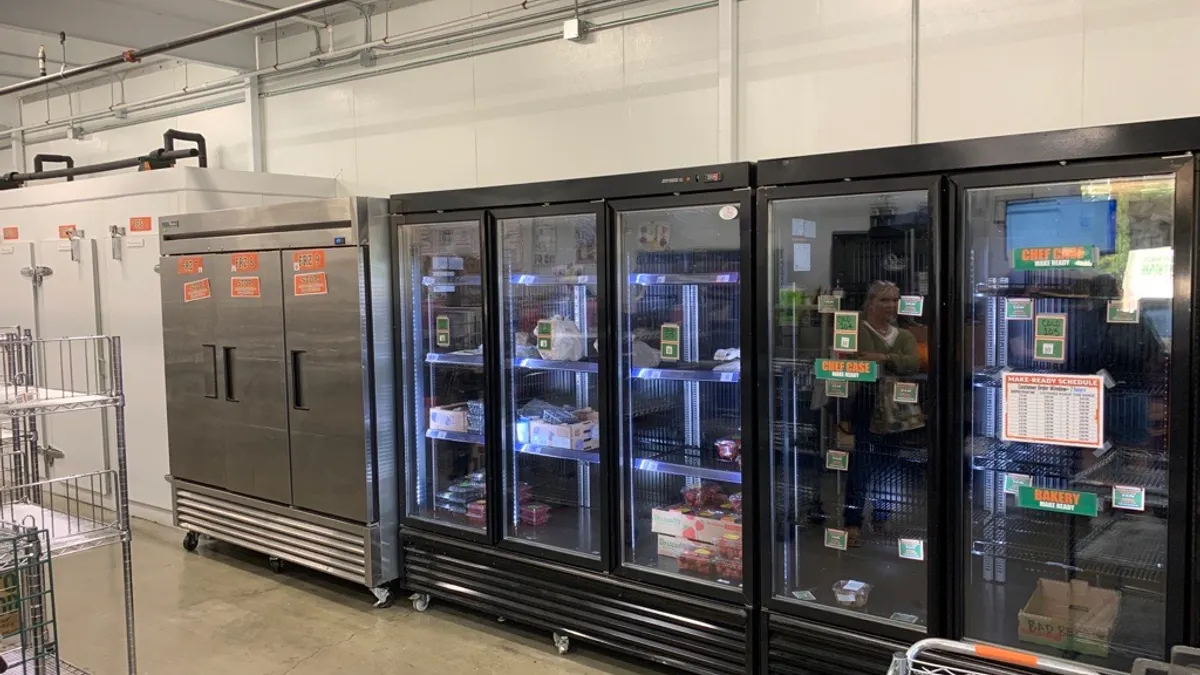
Rather than treating every increase in cold-storage demand as a permanent construction or equipment purchase, retailers can use RaaS to add refrigeration capacity where it is needed. That can include modular walk-in coolers, self-contained display refrigeration and other scalable refrigerated solutions.
The model can also incorporate installation, commissioning, preventative maintenance, service, and eventual removal. This allows the retailer to focus on how the capacity supports the operation rather than managing another group of refrigeration assets.
More importantly, it creates options.
A retailer could expand cold storage at an existing store as online orders increase. A new fulfillment concept could be tested before permanent infrastructure is installed. Equipment could support a facility during construction or expansion. Refrigeration layouts could also change as the retailer learns more about how customers are using delivery, pickup and ship-to-home.
That flexibility has value in a market where consumer behavior is moving quickly.
The next eCommerce conversation is a physical one
Brick Meets Click's data makes a compelling case that online grocery is no longer a side channel. Consumers are ordering more frequently, using multiple fulfillment methods, and increasingly embracing faster delivery. Retailers now have to determine how their physical networks will respond.
Technology will continue to play an enormous role. Better forecasting, automation, order management, and last-mile logistics will all help retailers improve the eCommerce experience. But every digital grocery order eventually meets the physical world.
Products need to be stored. Orders need to be picked. Refrigerated and frozen items need to remain cold. And if consumers expect those products faster, retailers need enough temperature-controlled capacity in the right places to make that possible.
The retailers best positioned for the next phase of eGrocery may not be those that simply build the most infrastructure. They may be the ones that build the ability to change it