Dive Brief:
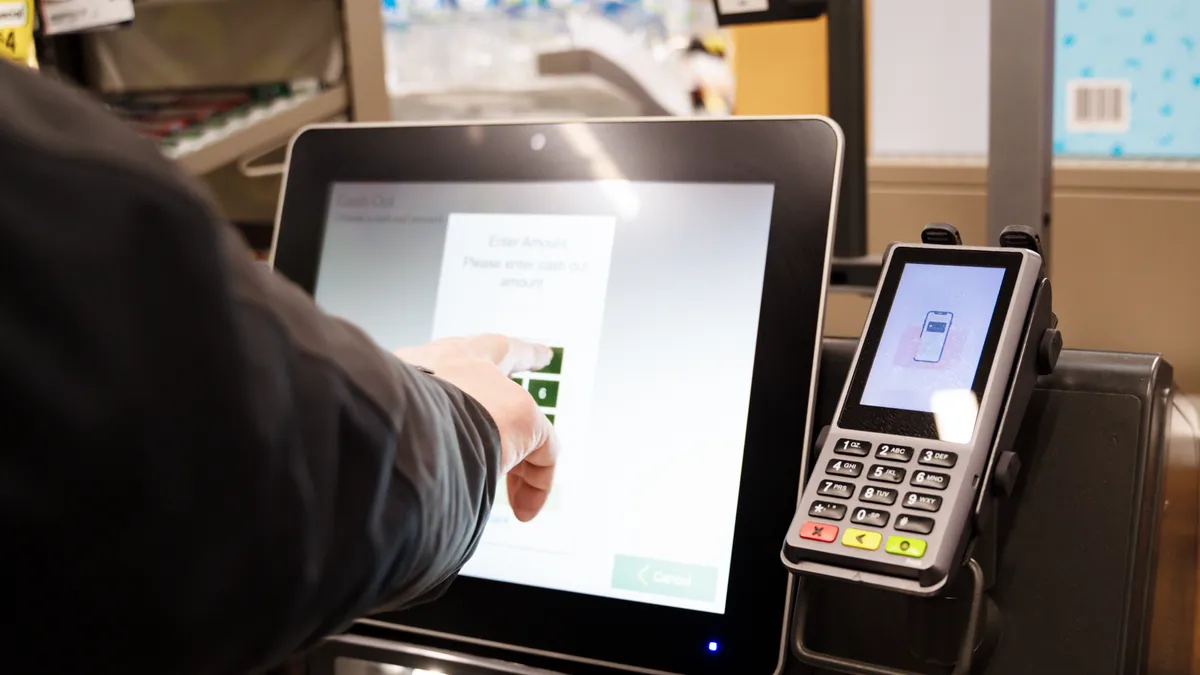
- Rhode Island Gov. Dan McKee on Thursday signed into law a bill that mandates a staffing ratio for the self-checkout area in grocery stores.
- The legislation, which the United Food and Commercial Workers Local 328 supported, will require stores to assign at least one worker to staff every three self-checkout stations.
- The law goes into effect on Jan. 1, 2027, and its passage marks the first statewide self-checkout staffing ratio in the U.S. as other states consider restrictions on self-checkout.
Dive Insight:
The lawmakers who sponsored the newly enacted Rhode Island law did so because they were concerned that self-checkouts can overtax workers and frustrate shoppers, particularly older ones, according to a press release from the state’s General Assembly.
The law aims not only to improve the customer experience but also to curb theft at self-checkouts, the UFCW said. The labor group cited a report by Capital One that found that retailers in Rhode Island lost $244 million in 2022 due to theft.
California, Connecticut, Massachusetts, New York, Ohio and Washington state are considering similar self-checkout restrictions in a bid to reduce shoplifting, USA Today reported.
Once the Rhode Island law takes effect, employees assigned to the self-checkout area must be relieved of all other duties, including working at manned checkout counters. Grocery stores won’t have to follow the staffing ratio during off-peak hours — before 8 a.m. or after 8 p.m. — or during any declared state of emergency or severe weather alert.
Grocers that violate the law will first receive a written warning before facing fines for multiple violations that occur at the same store. The fines, which cannot exceed $500 per day, will match wages for one four-hour shift based on the highest wage for hourly retail clerks for each day a violation occurs.
The passage of the Rhode Island legislation notches another win for the UFCW, as the bill was part of the labor group’s “Affordable Groceries and Good Jobs Campaign.” That campaign also aims to ban retailers’ use of electronic shelf labels and eliminate pricing practices that the labor group claims are discriminatory.
Correction: This story previously misstated when the self-checkout regulations go into effect. The law takes effect Jan. 1, 2027.